Are Loyalty Programs Worth It? The Real Points Math
Open your phone right now and count the loyalty apps. Go ahead, I'll wait. Coffee shop, drugstore, grocery chain, that airline you flew once in 2023, the sandwich place with the punch card that mysteriously resets every time you're one punch away from a free sub.
Now the uncomfortable follow-up question: how many of those programs have actually put money back in your pocket this year? Not points. Not "status." Not a congratulatory email. Actual dollars you didn't spend because a program covered them.
For most people, the honest answer is "one or two, maybe." Which is strange, because loyalty programs are pitched as free money — sign up, shop like normal, get rewarded. And sometimes that's exactly what happens. Other times the program is a beautifully engineered machine designed to make you spend $80 to "earn" $3.
This guide is about telling those two situations apart. We'll do the actual math on what points are worth, expose how tier systems keep you on the treadmill, show you the member perks that genuinely pay, and — the good part — teach you to stack member pricing with promo codes so the store's own loyalty machine works for you instead of on you.
What a Point Is Actually Worth (Spoiler: Less Than You Think)
Every loyalty program speaks its own currency. Stars, points, coins, "rewards cash," kicks, bucks. That's not an accident. Made-up currencies are hard to compare, and hard-to-compare numbers feel bigger than they are. Earning 500 points sounds fantastic. Earning 35 cents does not — even when they're the same thing.
So here's the single most useful skill in this entire article: convert every program back into dollars. The formula is simple:
value per point = dollar value of reward ÷ points needed to get it
Run that math on most retail programs and you'll find a point is worth somewhere around one cent — often less. Grocery and drugstore points frequently land in the half-cent range. A few generous programs hit two cents. Anything above that is rare enough to celebrate.
Let's translate some typical programs into real money:
- "Earn 1 point per $1, get $5 off at 500 points" → each point is worth 1 cent → you're getting 1% back. You'd have to spend $500 to earn a $5 reward.
- "Earn 10 points per $1, get a $5 reward at 5,000 points" → sounds ten times better, but it's the exact same 1% — each point is worth a tenth of a cent.
- "Spend $100, get $10 in rewards" → now we're talking. That's a genuine 10% back, and programs like this are worth actively using.
Once you see programs in percentages instead of points, the fog lifts instantly. A program returning 1% is background noise — nice if you're shopping there anyway, never a reason to choose the store. A program returning 5–10% is a legitimate discount engine. The marketing makes both look identical. The math never does.
The Earn Rate Is Only Half the Story
Two more numbers decide whether that percentage ever reaches your wallet:
- The redemption threshold. If rewards only unlock at $200 of spending and you shop there twice a year, you will never see a dime. A great earn rate you can't redeem is worth exactly zero.
- The expiration clock. Many programs quietly expire points after 6–12 months of inactivity. Industry surveys consistently find that a huge share of loyalty points — by some estimates roughly a third — are never redeemed at all. Every expired point is pure profit for the store and pure loss for you.
A program is only as good as the rewards you actually cash out. "I have 4,000 points somewhere" is not savings. It's a donation you haven't finished making yet.
Tier Systems: The Video Game You're Paying to Play
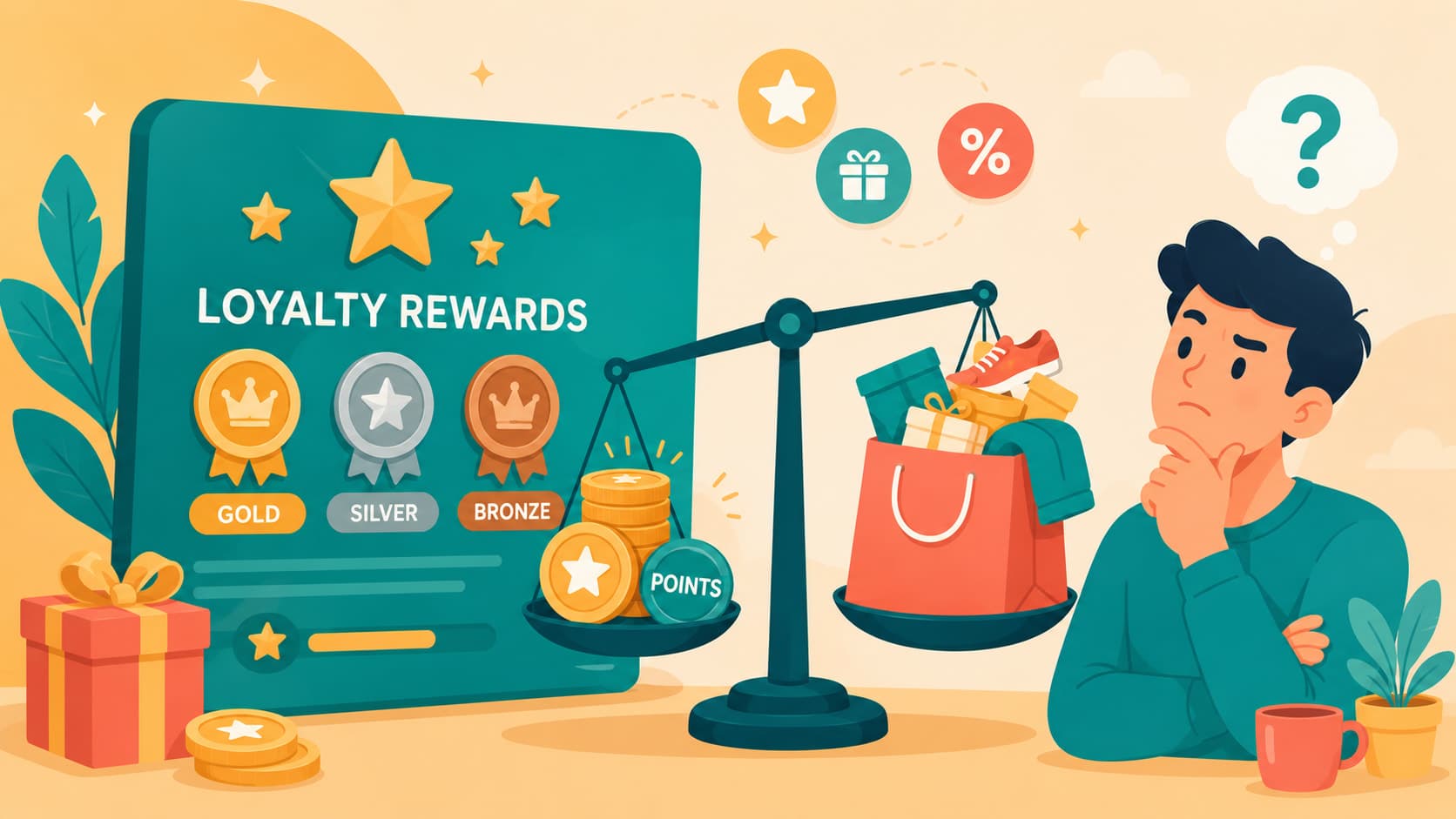
Bronze. Silver. Gold. Platinum. Diamond. If loyalty tiers feel like a video game, congratulations — you've spotted the design document. Tiers borrow the exact psychology that keeps people grinding levels at 2 a.m.: visible progress bars, status labels, and the gnawing fear of losing what you've "earned."
And to be fair, tiers can deliver real value. Free shipping at every level, early sale access, better return windows, boosted earn rates — for a store you genuinely shop at constantly, climbing a tier can be worth real money.
The trap is the climb itself. Tier systems are built to trigger two expensive behaviors:
- Threshold chasing. "You're only $120 away from Gold!" is one of the most effective spend-more prompts ever invented. Suddenly you're buying things you don't need to reach a status level whose perks you haven't even priced out.
- Status defense. Most tiers reset annually. So every year, the program asks you to re-earn your level — which means the spending treadmill never stops. Airlines perfected this; retail copied it enthusiastically.
The tier math test, with real numbers. Say Gold status requires $600 of annual spending and its perks are free shipping (worth about $6 per order) plus a 2x points boost:
- You place 8 orders a year → free shipping saves roughly $48
- The points boost takes you from 1% to 2% back on $600 → an extra $6
- Total perk value: about $54 a year — great if you'd spend $600 there anyway
- But if you only naturally spend $400 and buy $200 of extras to hit Gold, you just spent $200 to earn $54 in perks. That's a $146 loss wearing a gold badge.
The rule that protects you: tiers are a reward for spending you were already doing, never a target to spend toward. If your natural shopping earns the tier, enjoy it. If reaching it requires a single purchase you wouldn't otherwise make, let it go. Silver status with money in your pocket beats Gold status with a closet full of regret.
The Perks That Are Actually Worth Your Email Address
Enough tough love. Plenty of loyalty perks are genuinely excellent, and skipping them is leaving money on the table. Here's what to look for.
Birthday Rewards: The Free Money Holiday
Birthday perks are the closest thing loyalty programs have to a no-strings gift. Free menu items, $10–$15 off coupons, 20–25% off codes, free desserts — all for existing. A shopper who signs up for birthday rewards at a dozen stores they already like can quietly collect $50–$150 in freebies and discounts every year during their birthday month.
Two tips to maximize it: most programs give you the whole month (or at least a week) to redeem, so you can spread out the free lattes instead of attempting a single heroic birthday binge. And use a dedicated deals-only email address, because birthday-club inboxes get loud.
Member-Only Pricing and Codes
This is the perk that's been eating the traditional sale. More and more retailers now show two prices: the regular price and a lower "member price" that unlocks the moment you join the free program. Same item, same store, instant 10–30% difference — the only cost is an email address.
Members also get exclusive promo codes: welcome codes, "we miss you" codes, early access to clearance, app-only offers. These are often better than anything available to the general public, because retention discounts are where brands spend their real money.
The Quiet Perks People Forget to Value
- Free shipping with no minimum — at $5–$8 per order, this can out-earn the points side of the program several times over.
- Extended returns — member return windows of 60–90 days versus 30 for everyone else. Worth actual money the first time a gift misses.
- Free perks with a real cash value — birthday freebies, free alterations, free samples, members-only price adjustments if an item drops after you buy.
The Stack: Member Pricing + Promo Code + Rewards
Here's where loyalty stops being a marketing program and starts being a savings strategy. Loyalty perks are not an alternative to promo codes — they're a layer that stacks with them. Most stores treat member pricing as a price, not a coupon, which means a promo code usually applies right on top of it. Then your rewards earn on whatever you actually paid.
Watch the layers work on a $90 pair of sneakers:
- Member price knocks it to $72 (20% member discount)
- A 15% promo code brings it to $61.20
- The purchase earns a $5 loyalty reward for your next order → effective cost $56.20
That's 37% off without waiting for a sale — just free membership, one code, and letting the points do their thing.
The order of operations matters: join the free program first, let member pricing apply, then add the best available promo code at checkout. Before any order at a store where you hold a membership, take thirty seconds to check for a current code — the store pages on Lyfestic organize verified codes by retailer, so you can jump straight to the brand you're buying from instead of gambling on random search results.
One caveat: some stores exclude member-priced items from additional codes. The checkout total will tell you instantly, and even when the code is blocked, the member price alone usually still beats the public price. You lose nothing by trying.
When Loyalty Pays vs. When It Plays You
A simple honesty test sorts every program in your life into "keep" or "quit":
- Loyalty pays when the store was already your store. Groceries, gas, pharmacy, the coffee you were buying regardless — a program layered on unavoidable spending is pure upside.
- Loyalty pays when the perks are unconditional. Member pricing, free shipping, birthday gifts — value you receive without changing your behavior at all.
- Loyalty plays you when it changes where you shop. Driving past a cheaper store to "earn points" worth 1% is paying a premium for the privilege of being marketed to.
- Loyalty plays you when it changes how much you spend. Padding orders to hit point thresholds, chasing tiers, buying because points "expire soon" — the program is now steering, and it doesn't drive toward your savings.
- Loyalty plays you when you can't name your balance. If you don't know roughly what you've got and what it's worth, you're feeding a machine that's betting you'll never collect. Statistically, it's a good bet.
The pattern is almost embarrassingly simple: programs reward the shopper who would have shopped there anyway and punish the shopper who rearranges their life around points. Be the first one.
5 Loyalty Mistakes That Turn Rewards into Regret
- Valuing points in points. "I earned 2,000 points!" means nothing until you convert it. If those points are worth $2 on a $200 spend, react accordingly — with a shrug.
- Letting points expire. Set a calendar reminder to check balances twice a year. A reward you never redeem is a discount you paid full price to not receive.
- Spending to reach a threshold. Buying $30 of stuff to unlock a $5 reward is a 17% surcharge disguised as a prize. Only cross thresholds with purchases you already planned.
- Ignoring the stack. Redeeming a reward at full price when a promo code was available means you spent your points covering a discount the store would have given you anyway. Code first, then points.
- Joining everything. Twenty programs you barely use means twenty inboxes of temptation and zero meaningful rewards. Keep memberships at the 5–8 stores you genuinely frequent and unsubscribe from the rest. Fewer programs, fatter balances, fewer impulse triggers.
Frequently Asked Questions
Are free loyalty programs actually free?
You pay no money, but you do pay with data — your purchase history is the product. For most shoppers that trade is worth it at stores they already use, since member pricing and birthday perks have real cash value. Just use a dedicated deals email and skip programs at stores you rarely visit.
Are paid loyalty programs ever worth the fee?
Only when the math clears the fee with room to spare. A $49-per-year program needs to reliably deliver more than $49 in shipping, discounts, and perks you would have paid for otherwise. Heavy, frequent shoppers at that specific store often come out well ahead; occasional shoppers almost never do. Estimate your last year's orders before paying for the next one.
Can I use a promo code and my loyalty rewards on the same order?
Usually, yes. Most stores treat rewards as a payment method or automatic discount and promo codes as a separate field, so they stack. The reliable order: let member pricing apply, enter the promo code, then apply your reward. If a store blocks the combination, the checkout total will show it before you pay.
What's the best way to keep points from expiring?
Two habits: check balances during a twice-a-year "loyalty audit" (many programs reset the expiration clock with any activity, even a tiny purchase), and redeem early rather than hoarding. Points don't earn interest, and programs devalue rewards far more often than they improve them. A reward redeemed is a reward guaranteed.
Do loyalty programs make people spend more?
That's the entire business model — members reliably spend more than non-members, which is why stores fund the perks. But the extra spending comes from threshold chasing and tier climbing, not from membership itself. Join the program, take the unconditional perks, ignore the prompts to spend "just a little more," and you keep the upside without funding it.
The Verdict: Tool and Trap — You Pick Which
So, genius savings tool or marketing trap? Annoyingly, the honest answer is both — and the deciding factor is not the program. It's you.
Used passively and selectively, loyalty programs are quietly excellent: member pricing on things you were buying anyway, birthday gifts for existing, free shipping, and a few percent back that compounds over a year of normal life. Used the way the marketing department hopes — chasing tiers, padding carts, hoarding points until they expire — the same programs become a surcharge with a progress bar.
Keep the memberships at stores you genuinely use. Convert every point balance into dollars before you get excited. Never spend a cent you weren't going to spend. And always, always stack member pricing with a promo code before you check out.
Ready to stack your member perks with a working code?
Find verified promo codes for your favorite stores and check the latest promotions before your next order — because member pricing plus a promo code beats either one alone, every single time.
Happy saving! 🛍️
Related Articles
Explore more articles you might like