The Psychology of Discounts: How Stores Get You to Spend
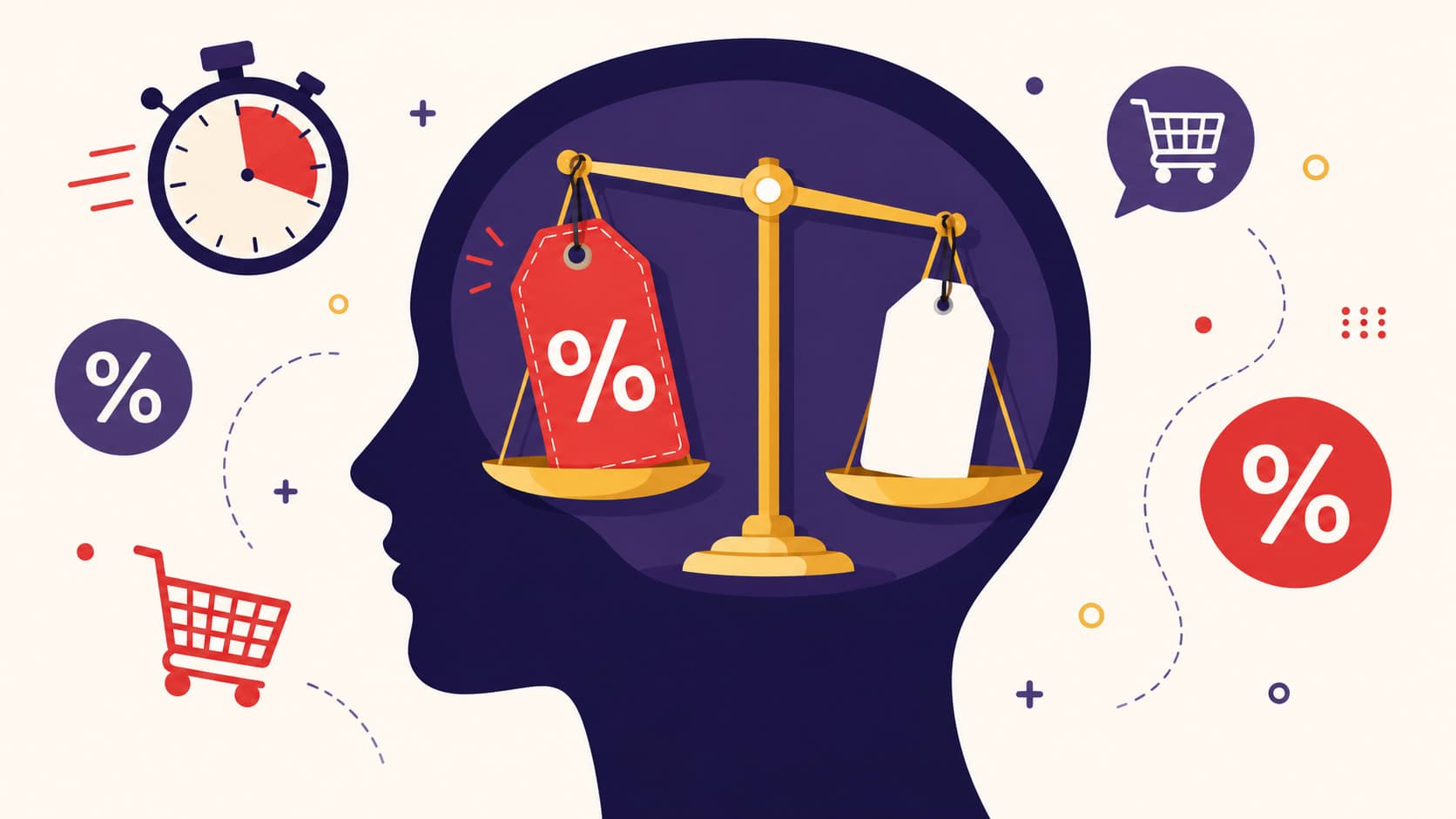
Your brain makes roughly 35,000 decisions a day, and it's exhausted. So when it sees a red tag that says "was $89.99, now $44.99," it doesn't do math. It feels something — a little jolt of winning — and reaches for the credit card before the rational part of you has even finished reading the price.
Retailers know this. Not vaguely, not intuitively — they know it the way a chess player knows openings. Entire teams of pricing analysts, behavioral economists, and conversion specialists spend their careers studying exactly how your brain responds to a countdown timer, a crossed-out price, or the words "members only."
Here's the good news: every one of their tricks has a name, a mechanism, and a counter-move. And once you can see the machinery, it stops working on you. This guide walks through the six most common psychological pricing tactics stores use in 2026, shows you the dollar math behind each one, and gives you a specific defense for every single trick.
Think of it as reading the other team's playbook. Legally.
Tactic #1: Anchoring — The "Was" Price That Never Was
Anchoring is the granddaddy of pricing psychology. The first number your brain sees becomes the reference point — the anchor — and every number after it gets judged against that anchor instead of against reality.
That's why sale tags almost never just say "$44.99." They say "$89.99 $44.99." The crossed-out number does all the heavy lifting. You're no longer asking, "Is this jacket worth $45 to me?" You're thinking, "I'm saving $45!" — which is a completely different question, and one the store would much rather you answer.
The dirty secret: that $89.99 "original" price is often inflated, ancient, or barely real. Some retailers list items at a "regular" price that the product sold at for a week — or never — before dropping to the "sale" price it was always meant to sell at. The discount isn't a discount. It's a costume.
Real-world anchor math. A patio set is tagged:
- "Was $1,299, now $699" — feels like you saved $600
- A price-history check shows it sold at $749 for eight of the last twelve months
- Your actual savings versus the true street price: $50, not $600
Still a fine deal — but you should decide based on $50, not the fantasy $600.
Your Defense: Judge the Price, Not the Discount
- Ignore the crossed-out number entirely. Cover it with your thumb if you have to. Ask one question: "Would I pay this price if there were no sale tag?"
- Check price history. Free price-tracking tools show you what an item actually sold for over the past year. Thirty seconds of checking deflates most fake anchors instantly.
- Compare across stores. If the "70% off" price at one store matches the everyday price at three others, you've found your answer.
Tactic #2: Urgency and Scarcity — The Clock That's Always Ticking
"Only 3 left in stock!" "Sale ends in 02:14:37!" "17 people are viewing this item right now!"
Urgency works because your brain treats a disappearing opportunity like a threat. Under time pressure, people shift from careful evaluation to fast, emotional decision-making — which is precisely the mode retailers want you in. A shopper who thinks overnight compares prices. A shopper with a countdown timer clicks "buy."
And here's the part that should genuinely annoy you: much of it is theater. Plenty of countdown timers reset the moment they hit zero. "Only 3 left" sometimes refers to a single warehouse — or nothing at all. Those "17 people viewing" counters? Some are generated by a random number script. This isn't speculation; regulators in the U.S. and Europe have taken action against retailers for exactly these fake urgency displays.
Your Defense: The 24-Hour Rule
- Impose your own timer. For any unplanned purchase over $50, wait 24 hours. If the deal is real, it will almost always survive the night — and if it doesn't, an equal or better one is usually weeks away.
- Test the timer. Open the page in a private browsing window. If the "expiring" countdown starts fresh, you've caught the store performing urgency, not offering it.
- Remember the retail calendar. Sales are cyclical, not once-in-a-lifetime. The event that "ends tonight" has a sibling coming next month. Genuine one-time deals are rare enough to be newsworthy.
Tactic #3: Decoy Pricing — The Option That Exists to Be Rejected
This one is sneaky-elegant. Stores sometimes add a deliberately unattractive option to a lineup — not because anyone will buy it, but because it makes another option look brilliant by comparison.
The classic example is the popcorn stand: small for $5, large for $8.50. Most people buy the small. Then the theater adds a medium for $8 — and suddenly the large looks like an obvious steal ("only 50 cents more than the medium!"). Nobody buys the medium. The medium's entire job is to sell larges.
Online, you'll see this in subscription tiers, bundle offers, and "good/better/best" product lineups. That weirdly overpriced middle option isn't a pricing mistake. It's a decoy, and it's pointing you exactly where the store wants you to go — usually one tier above what you actually need.
Decoy math in the wild. A streaming-box lineup:
- Basic: $29 — does everything most people need
- Plus: $54 — adds one minor feature (the decoy)
- Max: $59 — "only $5 more than Plus!"
Shoppers compare Max to Plus and feel clever paying $59. But the real comparison is Max versus Basic: is that feature bundle worth an extra $30 to you? For most people, it isn't — and the $29 box was the win all along.
Your Defense: Compare to Your Needs, Not to the Menu
- Decide what you need before you look at the options. Write it down if it's a big purchase. Then buy the cheapest option that covers your list — and nothing more.
- Spot the orphan. If one option seems designed to be ignored, it probably is. Its presence should make you more suspicious of the "obvious" choice, not less.
- Price the upgrade in absolute dollars. Never in "only $5 more than" terms. The store picked that comparison for you; pick your own.
Tactic #4: Free Shipping Thresholds — Engineered Just Out of Reach
"Free shipping on orders over $50" sounds like generosity. It's actually one of the most precisely calibrated numbers in retail.
Stores set their threshold slightly above their average order value on purpose. If customers typically spend $42, the threshold lands at $50 — close enough that hitting it feels easy, far enough that hitting it requires adding something. And people hate paying for shipping so much that they'll routinely spend $15 on filler to "save" $7.99 in shipping fees.
Read that again: spending $15 to save $8. Framed as avoiding a fee, it feels like a win. Framed honestly, it's paying nearly double the shipping cost for an item you didn't plan to buy.
Your Defense: Do the Filler Math
- Compare the shipping fee to the filler cost. If shipping is $7.99 and you'd need $12 of extra stuff to dodge it, paying for shipping is the cheaper move. This feels wrong and is right.
- Keep a "threshold list." A running note of small items you genuinely need — socks, phone cables, coffee filters. When you need to pad a cart, pull from the list instead of the store's "you might also like" suggestions. Now the filler is a planned purchase at a convenient time.
- Look for a free shipping code first. Many stores run them alongside the threshold; a quick check on Lyfestic's store pages takes seconds and can make the whole threshold game irrelevant.
Tactic #5: Loss Aversion — The Fear of Missing the Deal
Behavioral economists have measured this repeatedly: losing $50 feels roughly twice as bad as gaining $50 feels good. We are wired to dodge losses far more aggressively than we chase gains — and marketers weaponize that wiring daily.
Notice the language of promotions. "Don't miss out." "Last chance." "Your 20% off expires tonight." "You're leaving $15 in rewards on the table." None of these frame the purchase as gaining a product. They frame not purchasing as losing something you somehow already own — a discount, a reward, an opportunity.
Abandoned-cart emails are loss aversion in its purest form: "Your cart is waiting… and your items are almost sold out." You put three things in a cart while half-distracted, and now a store is telling you that walking away means losing them. You can't lose what you never bought. But your brain isn't so sure.
Your Defense: Reframe the "Loss"
- Translate every "you'll lose X" into "you'll keep Y." Skipping a "$15 off $75" offer doesn't cost you $15. It keeps $75 (or $60) in your account. The store's frame counts the discount; your frame should count the spend.
- Treat expiring coupons as options, not obligations. An unused coupon that expires costs you exactly $0. A coupon that talks you into an unplanned $60 purchase costs you $60 minus whatever you saved.
- Flip abandoned-cart pressure to your advantage. If you genuinely want the item, abandoning the cart on purpose often triggers a discount email within a couple of days. The store's psychology tool becomes your negotiating tactic.
Tactic #6: "Member Exclusive" — Selling You Belonging
Humans are tribal. We like being insiders, and we assign extra value to things that outsiders can't have. Retail figured this out long ago, which is why everything is now a "club": member pricing, VIP early access, exclusive drops, insider rewards, loyalty tiers with names like Gold and Platinum.
Some of these programs deliver real value. Plenty exist mostly to do three things: harvest your data, increase your visit frequency, and make ordinary discounts feel special. A "member exclusive 15% off" is often just… 15% off, wearing a velvet rope. The exclusivity is the product.
Paid memberships raise the stakes further, because once you've paid, the sunk cost pushes you to shop there more — "I have to make my membership worth it" — which is exactly the behavior the fee was designed to create.
Your Defense: Audit the Perks Like an Accountant
- For free programs: join freely, but use a dedicated deals-only email address and never let "earning points" justify a purchase you wouldn't otherwise make. Points are a rebate on planned spending, not a reason to spend.
- For paid memberships: do an annual audit. Add up what the perks actually saved you last year and compare it to the fee. A $99 membership that saved you $60 is a $39 loss with good branding.
- Ignore the status theater. Tier names, badges, and "VIP" labels cost the store nothing and are worth exactly that. Only countable dollars count.
5 Mistakes That Keep the House Winning
Knowing the tactics is half the battle. These habits are the other half — the unforced errors that hand your money back to the store:
- Shopping without a number in mind. If you don't know what an item should cost, every anchor works on you. Two minutes of price-checking before you browse is armor.
- Confusing "saved" with "spent." The receipt that says "You saved $34!" also says you spent $86. Stores print the first number bigger for a reason. Read the second one.
- Shopping while emotionally hungry. Stress, boredom, and doom-scrolling all lower your resistance to urgency and loss framing. The tactics above hit twice as hard at 11 p.m. on a rough day. Know your weak hours and keep the apps closed.
- Letting the store set the comparison. "Only $5 more than the mid tier," "$2 a day," "less than your daily coffee" — these are all frames someone chose for you. Recompute in plain monthly or total dollars, always.
- Assuming you're immune. The most persuadable shopper is the one who's certain they can't be persuaded. These tactics work on pricing experts who study them for a living. Humility plus a 24-hour rule beats confidence every time.
Frequently Asked Questions
Are fake "was" prices actually legal?
It's a gray zone that regulators keep tightening. The FTC and several state laws prohibit deceptive former-price claims, and retailers have paid multi-million-dollar settlements over inflated reference prices. But enforcement can't catch everything, so plenty of soft-fake anchors still make it to your screen. Your best protection is a price-history check, not the law.
Do countdown timers ever reflect a real deadline?
Sometimes, yes — flash sales, holiday events, and inventory clearances can have genuine end times. The tell is what happens afterward: a real sale ends and prices go back up; a fake one quietly restarts. If you've seen the same store "ending in 3 hours" three weekends in a row, you have your answer.
Is it bad to use these psychological tricks to my advantage?
Not at all. Abandoning a cart to trigger a discount email, waiting out fake urgency, or joining a free program purely for the welcome code are all fair play. Stores design these systems knowing some shoppers will optimize them — the discounts are budgeted for. You're just claiming your share.
How do I know if a loyalty membership is worth paying for?
Track it for one year. Note every perk you actually used — free shipping, member discounts, rewards redeemed — and total the real dollar value. If that number beats the annual fee by a comfortable margin, renew. If it's close or below, cancel and put the fee toward, well, anything else.
What's the single most effective defense against all of these tactics?
The 24-hour rule. Nearly every tactic in this article — urgency, loss aversion, anchoring, decoys — depends on you deciding quickly and emotionally. Time is kryptonite to all of them. One night of sleep turns most "must-buy" moments into "what was I thinking" moments, and the deals that survive the wait are the ones worth taking.
The Bottom Line: See the Trick, Keep the Money
None of this means discounts are a scam or that stores are evil. Real deals exist every single day — the coupon codes, clearance events, and cash-back offers we track are proof. The point is that pricing is a designed experience, built by smart people to steer your decisions, and the shopper who understands the design pays less than the one who doesn't.
So keep the playbook handy:
- Anchors: judge the price, not the discount
- Urgency: impose your own 24-hour timer
- Decoys: compare options to your needs, not to each other
- Shipping thresholds: do the filler math before padding the cart
- Loss framing: count what you keep, not what you "miss"
- Memberships: audit the perks in real dollars, annually
The stores will keep running their plays — they can't help it, the plays work on almost everyone. Your job is simply to stop being almost everyone.
Ready to play offense instead of defense?
Skip the fake urgency and go straight to real, verified discounts: browse coupon codes by store or check this week's live promotions on Lyfestic — no countdown theater required.
Shop smart. The house doesn't have to win. 🧠
Related Articles
Explore more articles you might like