How to Spot Fake Deals and Coupon Scams Before You Pay
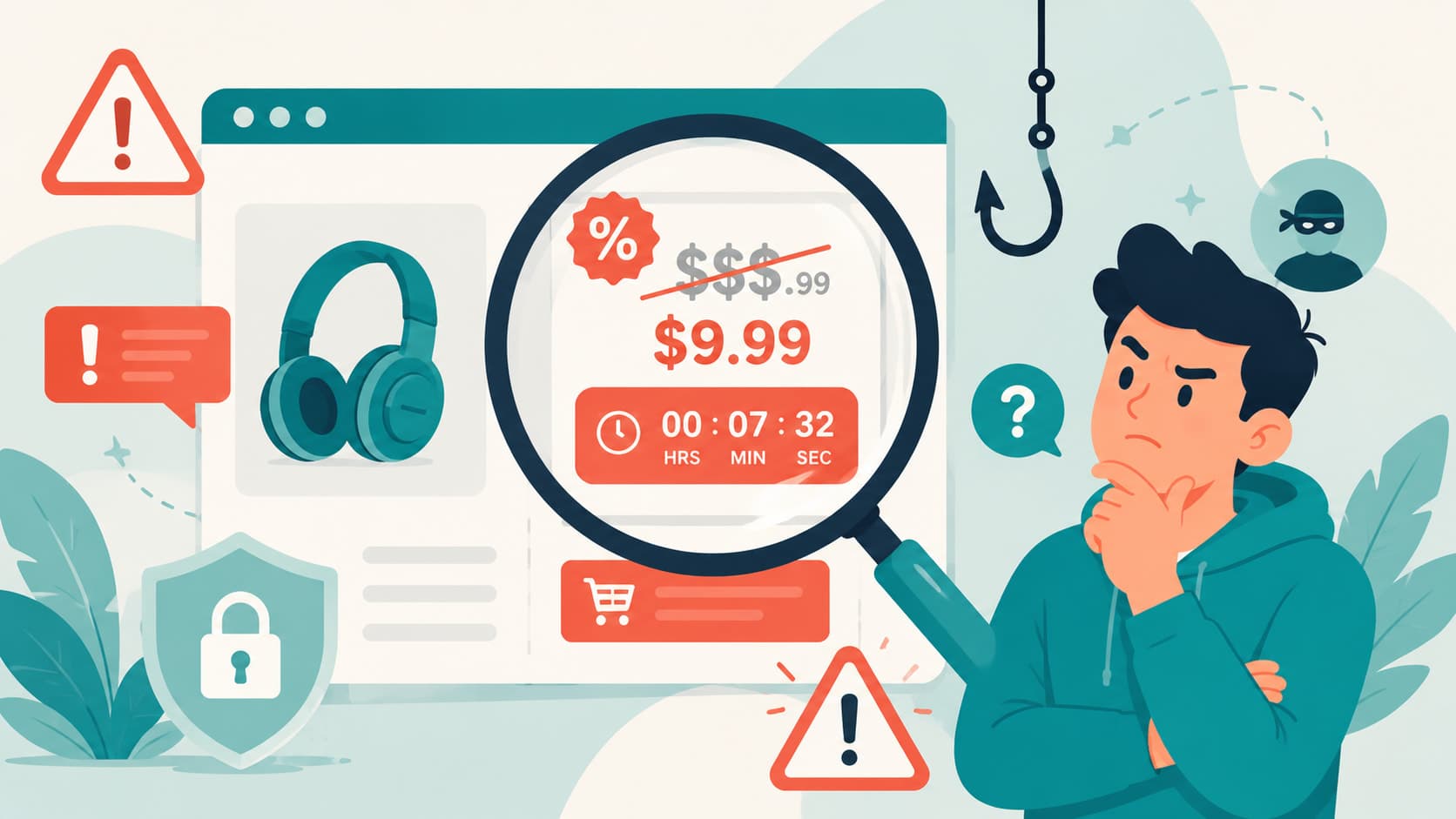
The ad shows a $1,249 robot vacuum — the fancy one with the self-emptying base — for $89. Today only. 94% off. There's a photo of a warehouse, a caption about "overstock liquidation," and 2,300 people in the comments saying "just ordered mine!!"
And for about four seconds, you believe it. Your finger hovers. $89! For that vacuum! You'd be crazy not to.
Then the rational part of your brain catches up and asks the only question that matters: why would anyone sell a $1,249 product for $89? The answer, of course, is that they wouldn't. Nobody liquidates inventory at a 94% loss. What's actually being liquidated in that transaction is your credit card number.
Fake deals are a real industry. The Federal Trade Commission logs billions of dollars in online shopping fraud losses every year, and the fastest-growing flavor is exactly this: fake stores, fake discounts, and fake coupon sites dressed up to look like the real thing. The good news? Once you know the tells, these scams become almost embarrassingly easy to spot. That's what this guide is for.
The Anatomy of a Fake Deal
Scam deals aren't random — they're built from a small set of reusable parts. Learn the parts, and you'll recognize the machine no matter what costume it's wearing.
Trick #1: The Inflated "Original" Price
This one is everywhere, and it's not limited to outright scams — plenty of technically legitimate retailers play this game too.
Here's how it works: a store lists an item with a big, crossed-out "was" price that the item never actually sold for. The "discount" is measured against a fantasy number, so the deal looks enormous while the real price is completely ordinary.
Watch the math on a real-world example:
- A blender's honest market price: $79 everywhere it's sold
- The listing shows:
$199now $89 — "55% OFF!" - What actually happened: you're being congratulated for paying $10 more than the going rate
That's the inflated-was-price trick in one line: a fake 55% discount hiding a real 13% markup.
The defense is simple: ignore the crossed-out price entirely. It's decoration. The only numbers that matter are the price you'd pay today and the price the same item sells for elsewhere. A thirty-second comparison search tells you whether "55% off" means anything at all.
Trick #2: The Countdown Timer That Never Ends
"Offer expires in 09:47… 09:46… 09:45…"
Here's a fun experiment: open that page in a private browser window. In a suspicious number of cases, the timer resets to a fresh ten minutes. It was never counting down to anything — it's a piece of JavaScript whose only job is to make your heart beat faster.
Urgency is the scammer's favorite tool because it attacks the exact thing that protects you: the pause. Every red flag in this article gets caught by a person who slows down for sixty seconds. So the timer's job is to make sure you don't. Legitimate sales have deadlines too, sure — but a real deal survives you taking a breath, checking a review, and comparing a price. A deal that punishes you for thinking is telling you what it thinks of your thinking.
Trick #3: The Too-Good-To-Be-True Code
Real promo codes cluster in a predictable range: 10%, 15%, 20%, occasionally 25–30% during major events, and the rare 50% on clearance nobody wanted. Stores fund these discounts out of their marketing budgets, and marketing budgets have limits.
So when a site promises SAVE90 for 90% off everything at a major retailer, ask yourself who's paying for that. The retailer isn't — no marketing department on earth approves giving away nine dollars of every ten. Which means the code either doesn't work (bait to get you onto a spammy page) or the "store" it works at isn't the store you think it is.
A quick gut-check scale for code believability:
- 10–25% off: completely normal, use with confidence
- 30–50% off: plausible during big sale events or on clearance categories — verify the terms
- 60–80% off sitewide: suspicious; almost always restricted, expired, or fake
- 90% off anything current and popular: it's bait. Close the tab.
Fake Coupon Sites: The Scam That Wears a Helpful Face
This one deserves its own section, because it targets exactly the kind of smart shopper who reads savings blogs. (Hi.)
Scammers know that millions of people search "[store name] coupon code" every day. So they build sites that look like coupon platforms — logo, code listings, green "Verified!" badges, the whole outfit — and then use that costume to do one of three things:
- Harvest your personal data. "Enter your email and phone number to unlock this code!" The code is fake or expired; your contact info is the product, sold to spam lists and robocallers.
- Grab payment details. The boldest version: a "membership" or "verification fee" to access codes, or a fake checkout that mimics the real store. Real coupon platforms never charge you and never ask for your card. Ever.
- Push malware. "Download our coupon toolbar to auto-apply this code." That download is not a coupon toolbar.
How Legit Coupon Platforms Actually Make Money
Understanding the real business model is the fastest way to smell a fake one, so here's the honest version.
Legitimate coupon sites — including Lyfestic — run on affiliate commissions paid by the stores. When you click through to a retailer and buy something, the store pays the platform a small percentage of the sale as a thank-you for sending a customer. The store treats it as a marketing cost, the same budget line as ads.
Follow the money on a typical $80 order:
- You find a 15% code and pay $68 instead of $80
- The store pays the coupon platform roughly $2–$5 in commission out of its own pocket
- Your cost for using the platform: $0.00
Everyone's incentives point the same direction: you save, the store gets a sale, the platform gets a commission. Nobody needs your phone number, your card, or a "small verification fee."
So the rule writes itself: the moment a coupon site asks you for anything beyond a click, it has stepped outside the legitimate business model — and you should step outside the site.
Checkout Red Flags: The Last Line of Defense
Suppose a fake deal got past your first filters and you're on a checkout page. There's still time. Scam checkouts leak tells everywhere, because building a convincing store is hard and scammers are lazy. Scan for these:
- No padlock, no HTTPS. If the address bar doesn't show
https://on a payment page, leave immediately. (Note the reverse isn't proof of safety — scammers can get HTTPS too — but its absence is disqualifying.) - A URL that's almost right. Real brand, wrong address: an extra word, a hyphen, a strange ending. If you're not on the domain you know, you're not at the store you know.
- Weird payment methods. Any "store" asking for a wire transfer, gift cards, payment apps like Zelle, or crypto is not a store. Those methods share one feature: no chargebacks. That feature was chosen for a reason.
- No contact information. Real retailers have a physical address, a customer service channel, and a return policy you can actually read. A contact page that's just an email form — or nothing at all — means there will be nobody to contact when your order never ships.
- Copy that reads slightly wrong. Odd grammar, prices in the wrong currency format, product descriptions that contradict the photos. Legitimate stores proofread; template scams don't.
- Reviews that are all perfect and all this week. Forty-seven five-star reviews posted within three days of each other is not a fan base. It's a spreadsheet.
Red Flags People Ignore (Even Smart Shoppers)
These are the mistakes that catch experienced deal-hunters — the ones who'd never fall for a fake Rolex email but still get burned once a year:
- Trusting a deal because a friend shared it. Scam posts spread through real people — that's the whole strategy. Your aunt sharing the $89 vacuum doesn't vet the vacuum; it just means the scam is working.
- Assuming ads on big platforms are screened. Fake stores buy ads on major social networks and search engines every day. Platforms remove them eventually; "eventually" is after the ad ran.
- Letting a small first order build false trust. Some scam stores ship your $15 order just fine — then vanish after your $200 one. One successful delivery is not a reputation.
- Reusing passwords on a sketchy checkout. Even if you catch the scam before paying, creating an account with your everyday password may have already handed it over. Use unique passwords, always.
- Paying with a debit card. Credit cards offer strong fraud protection and easy chargebacks; debit cards pull real money from your real account and getting it back is slower and messier. Online, credit wins.
- Feeling too embarrassed to report it. If you do get stung, dispute the charge with your card issuer and report the site to the FTC at reportfraud.ftc.gov. Fast reporting is how these operations get shut down — and how you get your money back.
The Safe-Couponing Checklist
Print this, save it, or just let it rewire your instincts. Before acting on any deal or code, run the ten-second version:
- Price-check the "deal." Search the exact product and see what it sells for elsewhere. A real discount survives comparison.
- Read the URL, letter by letter. Correct domain, HTTPS, no weird additions.
- Ignore countdown timers. A deal that can't wait sixty seconds isn't a deal.
- Never pay to see a coupon. Codes are free. Full stop. Sites that verify codes and show clear terms — like the store pages on Lyfestic — will never ask for money or personal data to reveal one.
- Keep payment inside protected rails. Credit card or trusted checkout services only; no wires, gift cards, or crypto.
- Check for a real return policy and contact info before the first order, not after the first problem.
- Trust the smell test. If a discount would lose the seller money, the seller isn't planning to sell you anything.
Notice what's not on this list: paranoia. The goal isn't to stop using coupons — codes and deals save careful shoppers hundreds of dollars a year, and the overwhelming majority of them are exactly what they claim to be. The goal is to spend those thirty verification seconds so the 2% of deals that are traps never get a shot at your wallet.
Frequently Asked Questions
How can I tell if a coupon site is legitimate?
Three quick tests: it never asks for payment or personal details just to show a code, it displays clear terms and verification dates on its codes, and it's transparent about earning store-paid commissions. If a site fails any of those, find another one.
Is a huge discount always a scam?
Not always — clearance items, open-box deals, and end-of-season purges can legitimately hit 70% off. The difference is context: real deep discounts appear on real retailer domains, on older or overstocked items, with normal checkout and return policies. A 90% discount on this year's hottest product from a site you've never heard of is a different story.
What should I do if I already paid on a fake store?
Act fast. Call your card issuer and dispute the charge, change any password you used on the site (and anywhere you reuse it), watch your statements for follow-up charges, and report the site at reportfraud.ftc.gov. Paid by credit card? Your odds of getting the money back are good.
Are countdown timers always fake?
No — flash sales and expiring codes genuinely exist. But legitimate urgency doesn't need to bully you. Treat every timer as decoration, verify the deal on its merits, and if it happens to expire while you're checking, another one will come along. They always do.
Can a fake code actually harm me, or is it just annoying?
The code itself is harmless — the worst it does at a real store's checkout is fail. The danger is what you do to get it: handing your email, phone number, card details, or a software download to the site dangling it. Get codes only from platforms that require nothing but a click.
The Bottom Line: Skepticism Is a Savings Strategy
Every scam in this article — the phantom $199 blender, the eternal countdown, the coupon site with a "verification fee" — depends on the same single ingredient: a shopper moving too fast to notice.
So the entire defense fits in one habit. Before you buy, pause. Compare the price. Read the URL. Ask who's paying for the discount. Sixty seconds, maybe less. The fake deals collapse under that tiny bit of scrutiny, and the real ones — the 15% codes, the genuine clearances, the stacked cash-back wins — come through it just fine.
Slow shoppers lose deals occasionally. Fast shoppers lose credit cards. Take the trade.
Want deals you don't have to squint at?
Every code on Lyfestic is verified, free, and click-to-use — no emails demanded, no fees, no timers screaming at you. Browse codes by store or check the latest promotions and save the safe way.
Shop sharp out there. 🔍
Related Articles
Explore more articles you might like