Save Big on Sports & Fitness Gear: The Smart Buyer's Guide
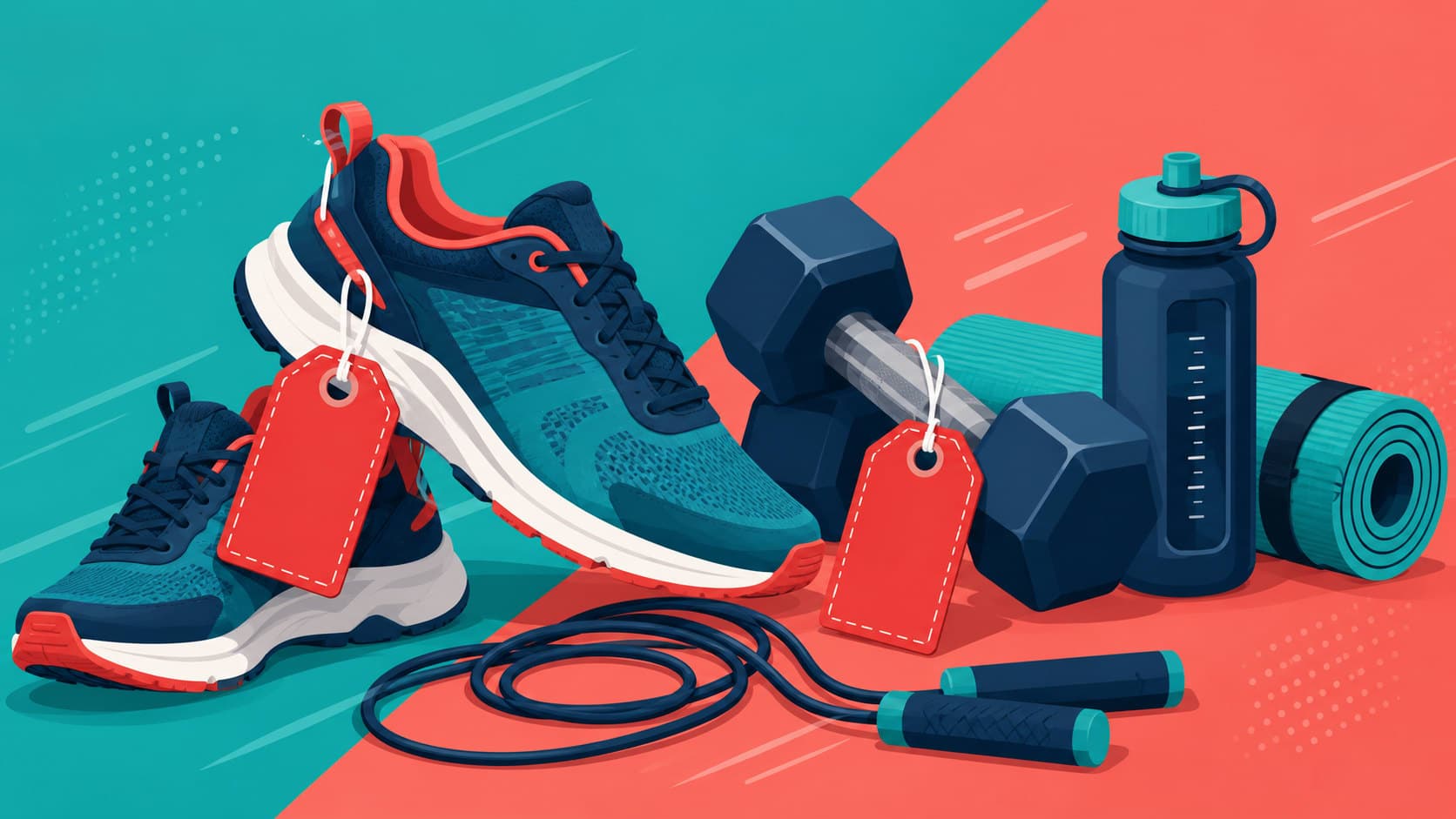
Two runners show up to the same 5K wearing the exact same shoe. Same model, same cushioning, same everything. One paid $160 at a mall store in March. The other paid $89 online in September — because the brand had just released the new colorway, and last season's version quietly dropped 40%.
Same shoe. Same miles. Seventy-one dollars apart.
That gap — between what gear costs and what gear has to cost — exists across the entire sports and fitness world. Shoes, dumbbells, treadmills, kayaks, ski jackets, yoga mats, golf clubs. The industry runs on model years, seasonal demand, and January motivation spikes, and every one of those patterns is something you can play to your advantage.
This guide walks through the six biggest levers: buying last season's models, timing the January and July sale windows, raiding online outlet sections, doing the honest gym-versus-home-equipment math, buying refurbished, and shopping seasonal sports in their off-season. By the end, paying full retail for fitness gear should feel about as appealing as running a marathon in jeans.
Why Sports Gear Is One of the Easiest Categories to Save On
Here's the open secret of the athletic industry: most gear doesn't meaningfully change year to year. A dumbbell is a dumbbell. A 2025 running shoe and its 2026 successor usually differ by a few grams of foam and a fresh paint job. But brands need you to feel like the new version matters — that's how they justify full price.
The result is a market with constant, predictable markdowns:
- Model-year turnover — every new release pushes last year's version onto the clearance rack
- Seasonal demand swings — nobody buys skis in April or kayaks in November, so prices collapse
- Resolution economics — the fitness industry banks on January sign-ups, so equipment sales cluster around motivation peaks
- Returns and floor models — lightly used gear flows back into outlets and refurb programs at deep discounts
Translation: in this category, the discount is almost always coming. Your only job is knowing where it lands and being ready when it does.
Strategy #1: Buy Last Season's Shoes — Your Feet Can't Read the Calendar
Running shoes are the clearest example of model-year pricing in all of retail. Most major brands refresh their core models every 12 months. The day version 14 launches at $160, version 13 — the shoe thousands of runners happily trained in all year — starts sliding toward $100, then $90, then sometimes $70.
And here's the kicker: the "update" is often just a new upper material or a tweaked lacing system. Running-shoe reviewers routinely note that year-over-year changes are minor. The midsole — the part that actually protects your knees — frequently carries over unchanged.
How to Work the Shoe Cycle
- Find your model, then shop one version back. If you love a shoe, search for the previous version number. It's usually 30–45% cheaper the moment its successor launches.
- Embrace the ugly colorway. Within a discontinued model, the loudest colors get discounted deepest. If you can live with neon green, you can save another $10–20.
- Buy two pairs when the price bottoms out. If you run regularly, you'll burn through shoes anyway. Two pairs of last year's model often cost less than one pair of this year's.
The math on a year of running (a pair every ~400 miles, two pairs a year):
- Buying new releases at launch: 2 × $160 = $320
- Buying last season's version on markdown: 2 × $95 = $190
- Stacking a 15% promo code on those markdowns: $161.50
That's $158.50 a year saved — for wearing the same shoe in a different color.
The same logic applies to cleats, basketball shoes, hiking boots, and trail runners. Version numbers are a discount map. Learn to read them.
Strategy #2: Circle January and July on Your Calendar
Fitness retail has two high tides, and they're absurdly predictable.
January: The Resolution Rush
Every equipment brand knows that millions of Americans decide to "get in shape this year" between December 26 and January 15. So they compete hard for those dollars: treadmills, exercise bikes, dumbbells, benches, and apparel all go on sale, often with free-delivery sweeteners on big items. If you're buying home equipment, the first three weeks of January are consistently among the best prices of the year.
July: The Mid-Year Clearout
Summer brings a second wave. Retailers clear spring inventory, mid-year sales events push sporting goods down across the board, and — bonus — the resolution crowd from January is now quietly reselling barely-used equipment. July is also when summer apparel starts marking down while it's still, you know, summer.
- Buying a big-ticket machine? Wait for January or July if you're within six weeks of either.
- Buying apparel? End-of-season clearance (late January for winter gear, late July onward for summer gear) beats event sales.
- Flexible on timing? Set a price alert now and let the calendar come to you. Deal roundups on the Lyfestic blog flag these windows as they open.
Strategy #3: Shop the Outlet Section Before the Main Site
Almost every major athletic brand runs a permanent online outlet — usually labeled "Sale," "Clearance," or literally "Outlet" — stocked with past-season gear at 25–50% off. It's the same warehouse, the same free returns, the same authenticity. Just last season's catalog.
Most shoppers browse the main page, fall for the full-price hero product, and never scroll to the outlet tab. Flip that habit:
- Start every session in the sale section. Decide whether anything there meets your need before you even look at new arrivals.
- Filter by your size first. Outlet inventory is broken and thin; filtering by size instantly shows what's actually available to you and saves the heartbreak of a perfect deal in the wrong size.
- Stack codes on top. Many brands allow promo codes on outlet items — and some run outlet-specific "extra 20% off sale styles" codes. That's a discount on a discount. Check the store pages on Lyfestic before checkout to see what's live for the brand you're buying from.
One caveat: outlet items are often final-sale or have shorter return windows. Read the policy before buying anything you're unsure about, especially shoes.
Strategy #4: Do the Gym vs. Home Equipment Math — Honestly
This is the biggest fitness money decision most people never actually calculate. Both paths can be smart. Both can be money pits. The difference is arithmetic, not vibes.
A 3-year comparison for a typical lifter:
- Gym membership: $45/month × 36 months + $50 annual fees = $1,770
- Home setup: adjustable dumbbells $300 + bench $150 + kettlebell $60 + bands and mat $60 = $570, bought once
If the home setup covers what you actually do, it pays for itself in about 13 months — and everything after that is free workouts.
But before you cancel your membership, be honest about three things:
- What do you really use at the gym? If your routine is dumbbells, a bench, and cardio you could do outside, home wins easily. If you genuinely use squat racks, pools, or classes, replicating that at home costs thousands.
- Will you actually work out at home? Equipment you don't use is the most expensive gear there is. A $570 setup used twice is a $285-per-workout habit.
- What does your gym cost per visit? Divide your monthly fee by your actual visits. $45 across 12 visits is $3.75 a session — fine. $45 across 2 visits is $22.50 a session, and you should either go more or pay less.
The hybrid answer is often the winner: a small home setup for busy weeks, plus a no-frills $10–25/month gym for the heavy equipment. That combination usually costs less than either extreme done lazily.
Strategy #5: Buy Refurbished — Especially the Big Machines
Treadmills, ellipticals, bikes, and rowers are where refurb shopping shines. These are durable machines with long mechanical lives, and the refurbished market is fed by returns, trade-ins, and gyms upgrading their fleets.
A certified refurbished machine typically sells for 30–50% below new, and the good programs inspect, repair, and warranty every unit. A $1,800 treadmill at $1,050 refurbished, with a warranty, is one of the best value plays in fitness.
Refurb Rules to Buy Safely
- Insist on a warranty. 90 days minimum; a year is better. A refurb with no warranty is just a used machine with a nicer adjective.
- Buy from the manufacturer or a certified dealer — not a random marketplace listing with stock photos.
- Check what "refurbished" meant. Good listings tell you: customer return, cosmetic blemish, or repaired unit. Cosmetic-blemish units are the sweet spot — full function, scratch-and-dent price.
- Compare against January sale prices on new. Occasionally a new machine on deep promotion beats the refurb price. Check both before committing.
For strength equipment — plates, bars, racks — used is even better than refurbished. Steel doesn't wear out. A secondhand set of weight plates at 50 cents a pound does exactly what new plates do at $1.50–2 a pound.
Strategy #6: Buy Every Seasonal Sport in Its Off-Season
Seasonal gear pricing is a sine wave, and most people buy at the exact peak — right when the season starts and demand is highest. Flip it:
- Ski and snowboard gear: buy in March–April, when resorts close and shops dump inventory at 40–60% off. Worst time: November.
- Bikes and cycling gear: buy in fall, when new model years arrive and current-year bikes get cleared. Worst time: spring.
- Kayaks, paddleboards, and water gear: buy in late August–September. Worst time: May.
- Golf clubs: buy in late fall and winter, or grab last year's driver when the new one launches. Worst time: April, when the itch hits everyone at once.
- Camping and hiking gear: buy at end-of-summer clearance. Tents and sleeping bags don't expire.
- Winter running and training apparel: buy in February–March clearance and store it. Cold weather comes back every year; full prices don't have to.
The only requirement is planning one season ahead. If you know you'll ski next winter, this spring's clearance is your Black Friday. The gear is identical — only the date on the receipt changes.
Mistakes That Turn Fitness Savings into Fitness Spending
The gear world has its own traps. These are the ones that cost people real money:
- Buying aspirational gear for an imaginary athlete. The $2,500 bike for someone who hasn't ridden in years, the full home gym for a habit that doesn't exist yet. Start cheap, prove the habit for 60 days, then upgrade. Discipline first, equipment second.
- Paying launch price for incremental updates. If the new model's changelog reads "updated upper, refreshed colorways," you're paying $60 extra for marketing.
- Ignoring the total cost of big machines. Delivery, assembly, and subscription content fees can add $300+ to a "sale" treadmill. Price the whole package, not the sticker.
- Skipping fit for price on shoes. A $70 shoe that wrecks your knees is the most expensive shoe you'll ever buy. Save on the model year, never on the fit.
- Forgetting the resale market exists. Every January purchase someone regrets becomes a March listing at half price. For barely-used equipment, secondhand in spring is a goldmine.
- Letting a sale set your shopping list. 50% off gear you didn't need is still 50% spent. The list comes first; the discount finds the list.
Frequently Asked Questions
Is last year's running shoe model really as good as the new one?
In most cases, yes. Major redesigns happen every few generations; the annual updates in between are usually cosmetic or minor. If the previous version worked for your feet and gait, buying it again at 30–45% off is one of the safest deals in sports retail. When a true redesign does happen, reviews will say so loudly.
When is the single best time to buy home gym equipment?
Early January and July sale events are the two strongest windows for new equipment, with November's holiday sales close behind. For used equipment, March and April are prime — that's when January's resolution purchases hit the resale market at steep discounts.
Is refurbished fitness equipment safe to buy?
Yes, if it comes from the manufacturer or a certified refurbisher and includes a warranty of at least 90 days. Those units are inspected and repaired before resale. What you want to avoid is uninspected "refurbished" gear from anonymous sellers with no warranty — that's just a used machine with unknown history.
Do promo codes work on sale and outlet items?
Often, yes — and it's the best stack in the category. Some brands exclude clearance items from codes, but many run outlet-specific codes like "extra 20% off sale styles." Always test the code on your discounted cart before assuming it won't work; the terms will tell you either way.
Is a cheap gym membership better than building a home gym?
It depends on what you use. If your routine needs heavy racks, machines, or a pool, a budget gym at $10–25/month is nearly impossible to beat at home. If you mainly use dumbbells and cardio, a modest home setup pays for itself within a year or two. Run your cost-per-workout for both options — the number usually makes the decision obvious.
The Finish Line
Sports and fitness gear rewards patient shoppers more than almost any other category, because its discounts run on schedules you can see coming:
- Shop one model year back on shoes and equipment — the performance carries over, the price doesn't
- Time big purchases to January and July, the industry's two built-in sale seasons
- Start in the outlet section and stack promo codes on top of markdowns
- Do the gym-versus-home math with your real habits, not your ideal ones
- Buy refurbished machines with warranties, and buy seasonal sports gear when the season ends
None of this requires sacrificing quality. You're buying the same steel, the same foam, the same fabric — just on your schedule instead of the marketing department's. That's the whole game: let someone else pay for being first, and pocket the difference every single season.
Ready to gear up for less?
Browse verified codes for your favorite sports and fitness brands, check the latest promotions before your next checkout, and let last season's price tags fund this season's miles.
Train hard, pay soft. 🏃
Related Articles
Explore more articles you might like