Turn Your Inbox Into a Coupon Machine: Email Savings Guide
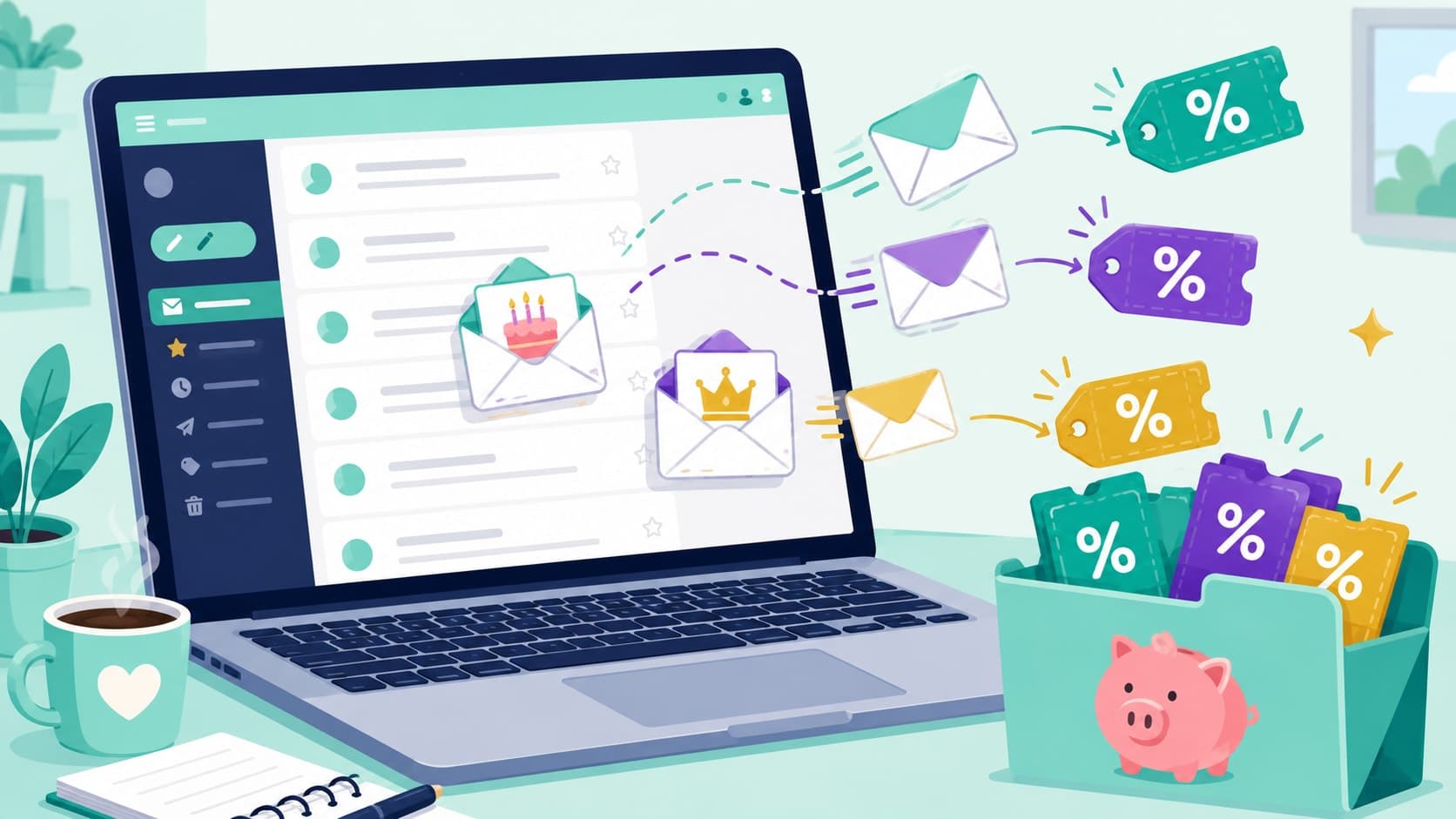
Go look at your Promotions tab right now. We'll wait. If you're like most people, there's a little badge sitting on it that says something like "247 unread."
Most shoppers see that number and feel one thing: guilt. All that clutter. All those brands shouting into the void. Time to select all, delete, and feel briefly, gloriously organized.
Here's the reframe that changes everything: that pile of "junk" isn't junk. It's an uncataloged stack of discounts — welcome codes, birthday freebies, early access passes, and we-miss-you offers — that brands paid real marketing dollars to send you. The average promotional email isn't spam. It's a coupon wearing a bad outfit.
The difference between people who save hundreds of dollars a year through email and people who drown in it isn't luck or patience. It's a system. And the system takes about twenty minutes to set up, runs itself forever, and turns your inbox into the single most reliable coupon source you own — better than any browser extension, because these codes are sent to you, often exist nowhere else, and almost always work.
Let's build that machine, piece by piece.
Why Brands Pay You to Open Their Emails
First, a quick peek behind the curtain, because understanding the incentives makes the whole strategy click.
Email is the cheapest marketing channel a brand has. Ads get more expensive every year; sending you an email costs a fraction of a cent. So brands will happily trade a 15% discount for a direct line to your attention. That's why nearly every online store greets you with the same offer: "Sign up and get 10% off your first order."
But the welcome code is just the front door. Once you're on the list, you enter a lifecycle: subscriber-only sales, early access windows, birthday gifts, and — if you go quiet — increasingly desperate "come back, we'll pay you" offers. Every stage has a discount attached, and every one is yours to collect.
Step One: Build a Deals-Only Email Address
Before you sign up for a single newsletter, do this — because it's the foundation everything else stands on.
Create a brand-new, free email address that exists for exactly one purpose: shopping signups. Something like yourname.deals@gmail.com. Takes three minutes, costs nothing, and solves the biggest objection people have to this whole strategy: "I don't want my inbox flooded."
Fair. So don't flood your inbox. Flood a different one.
What the Second Address Actually Gets You
- A clean personal inbox. Your real email stays for humans, bills, and work. Zero promo noise, forever.
- A searchable coupon archive. Every code you've ever been sent lives in one place. (More on why that's powerful in a minute.)
- Guilt-free signups. A brand wants your email in exchange for 15% off? Hand over the deals address without a second thought. You're not "giving them your email" — you're feeding the machine.
- A fresh identity for welcome codes. First-order discounts are tied to email addresses. A dedicated address that's never ordered from a store qualifies as "new" more often than your ten-year-old personal account does.
One rule keeps the system honest: never use the deals address for anything important. No banking, no accounts you'd panic about losing. It's a coupon bin, not a filing cabinet.
Step Two: Harvest the Welcome Codes
Now the fun part. Welcome offers — usually 10% to 20% off your first order, sometimes free shipping or a dollar amount like $15 off — are the most predictable discounts in all of retail. The signup box is right there on the homepage, usually in a popup that most people reflexively close.
Stop closing it. Start collecting.
Here's the move: sit down once with your deals address and sign up for every store you realistically shop at — the clothing brands you actually wear, the shoe store you hit twice a year, the pet supply site, the mattress company you'll need eventually. Ten to twenty signups, one sitting, done.
Let's put numbers on it. Say you sign up for 15 stores you genuinely buy from, and over the next year you place one first order at 8 of them, averaging $70 per order with a 15% welcome code:
- 8 orders × $70 = $560 in spending you were going to do anyway
- 15% off each = $84 saved — from one twenty-minute signup session
That's better than most cash back cards will pay you on $560, and it stacks on top of cash back.
One timing tip: sign up before you need the code. Some welcome emails arrive instantly, but others trickle in over a day or two, and a few brands make you wait out a "nurture sequence" before the good stuff lands.
Step Three: Use Your Inbox as a Coupon Archive
This is the habit that separates dabblers from professionals, and it costs you five seconds per purchase.
Before you check out anywhere, search your deals inbox for the store's name. That's it. Type "Levi's" or "Chewy" into the search bar and see what surfaces. You'll be shocked how often there's a live code sitting in an email you never opened — a subscriber sale from last Tuesday, a free shipping offer, a code from three weeks ago that hasn't expired yet.
Your inbox quietly becomes a personal, pre-verified coupon database with three advantages no public coupon list has:
- The codes were sent to you, so they're far less likely to be region-locked, dead, or "new customers only" surprises.
- Some are exclusive. Subscriber-only codes never appear on public sites at all. If you didn't get the email, the code effectively doesn't exist.
- The terms are attached. Expiration date, minimum spend, exclusions — it's all right there in the email instead of buried on some forum.
Pair this with a public source for stores you've never subscribed to — the searchable directory at Lyfestic's store pages covers the gaps your inbox can't — and you've got a two-layer system: inbox first, verified public codes second. Between the two, paying full price starts to feel like a clerical error.
Make the Archive Searchable on Purpose
A few small tweaks make retrieval even faster:
- Don't mass-delete. Storage is effectively free, and today's "clutter" is next month's search result. Archive, don't erase.
- Star the heavy hitters. When a genuinely big code arrives — 25% sitewide, $30 off — star it so it floats to the top later.
- Search smart. Queries like
from:nike codeor the store name plus "% off" cut straight through the noise.
Step Four: Join the Clubs That Pay You Back
Beyond the welcome code, brands run ongoing programs that reward you just for being on the list. Three are worth deliberately opting into.
Birthday Clubs: Free Stuff for Existing
Hundreds of brands — especially restaurants, beauty companies, and clothing retailers — send a gift during your birthday month: a free burrito, a free drink, a deluxe sample, 20% off anything. Individually, they're small. Collectively, a well-fed birthday list turns your birthday month into a week of free food and a stack of discounts. So whenever a signup form asks for your birthday, fill it in.
VIP and Early Access Lists
Subscribers routinely get sale access 24 to 72 hours before the public. That matters more than it sounds: for limited-stock items — popular sizes, bestselling colorways, doorbuster prices — the sale is effectively over by the time it officially begins. The public "sale" is the leftovers.
Some brands also run tiered lists ("text club," "insider program," app-subscriber lists) with deeper codes than the general newsletter. If a brand you buy from often offers a VIP tier, it's almost always worth the extra channel — that's where the best codes are sent first.
Win-Back Codes: Get Paid to Play Hard to Get
Here's the counterintuitive one. Brands track how often you open their emails and how recently you've purchased. Go quiet for a few months, and many of them enter panic mode — because a lapsed customer is cheaper to win back than a new one is to acquire. The result is the win-back email: "We miss you. Here's 20% off." Sometimes 25%. Sometimes a flat $20 with no minimum.
These are frequently the largest discounts a brand ever sends — bigger than their welcome offer, bigger than their holiday codes. And you earn them by doing absolutely nothing.
The patience math, using a $120 order at a store you buy from twice a year:
- Buy the moment you want it, no code: $120
- Use the standard 10% subscriber code: $108
- Wait for the 25% win-back code that shows up after 3 quiet months: $90
That's $30 saved for letting a purchase marinate — twice a year, at just one store. The brand literally rewards you for ignoring it.
The takeaway: for any non-urgent purchase at a store that has your email, silence is a strategy. Stop opening their emails for a while, and watch the offers escalate like a suitor who senses you're losing interest.
Step Five: The Unsubscribe Strategy (Yes, Quitting Is a Tactic)
It sounds backwards in an article about collecting newsletters, but knowing when to leave a list is part of the machine — for two reasons.
Reason one: pruning keeps the archive useful. A deals inbox works because searching it surfaces signal. If half your mail comes from brands you'll never buy from again — the store you ordered one gift from in 2024, the flash-sale site that emails three times a day — the noise starts burying the good codes. Once a quarter, spend five minutes unsubscribing from anything you haven't opened in six months and wouldn't miss. Ruthlessness is free.
Reason two: the exit door often has a coupon taped to it. Click "unsubscribe" on many lists and you'll hit a page pleading with you to stay — sometimes with a "get fewer emails" option, and sometimes with a straight-up discount for changing your mind. And even a completed unsubscribe isn't forever: resubscribe months later and some brands will run the welcome offer all over again, or at least restart the lifecycle that leads to those juicy win-back codes. You're not just decluttering — you're resetting relationships to their most generous phase.
Five Inbox Mistakes That Cost You Money
The machine is simple, but there are a few ways to gum up the gears. Avoid these:
- Using your personal email "just this once." One signup becomes twelve, and now your real inbox is the war zone you were trying to prevent. Every signup goes to the deals address, no exceptions.
- Buying because an email told you to. This is the big one. Brands send codes to create purchases, not just discount them. A 20% code on something you weren't going to buy isn't 20% saved — it's 80% spent. Let your shopping list drive; let the inbox discount the ride.
- Ignoring expiration windows. Welcome and win-back codes often expire in 7 to 14 days, and flash codes in 48 hours. When a code lands for something you actually want, check the deadline before you file it away for "later."
- Missing the code entirely. Some offers put the code in the email; others auto-apply through a button in the message. If a code "doesn't work" at checkout, go back and click through from the email itself — the discount may be tied to that link.
- Marking promos as spam instead of unsubscribing. The spam button trains your mail provider to hide the exact category of email this whole system depends on — including codes from brands you like. Unsubscribe from the ones you don't want; never nuke the category.
Putting It All Together: Your 20-Minute Setup
Here's the whole machine, assembled:
- Minute 0–3: Create your deals-only email address.
- Minute 3–18: Sign up for 10–20 stores you actually shop at. Enter your birthday wherever the form asks. Opt into VIP or early access tiers for your top two or three brands.
- Minute 18–20: Add one habit to your checkout routine: search the deals inbox for the store name before you pay.
From that point on, the system runs itself. Welcome codes arrive this week. Birthday gifts arrive on schedule. Early access invitations show up before every big sale. And the brands you quietly ignore will start sliding ever-larger discounts under your door, wondering what they did wrong.
Your inbox was always going to fill up with marketing email. The only question was whether it would be a mess you delete or a machine that pays you. Now it pays you — and for the stores that aren't in your archive yet, the current promotions on Lyfestic pick up the slack.
Frequently Asked Questions
Do I really need a separate email address for this?
Need? No. Want? Absolutely. The strategy works with one inbox, but the volume of promotional email will eventually annoy you into mass-unsubscribing — which dismantles your coupon archive. A dedicated address costs nothing, takes three minutes, and lets the system run at full volume without touching your real life.
How long until a "we miss you" win-back code shows up?
It varies by brand, but the common window is 60 to 120 days after your last purchase or last email open. Retailers with frequent purchase cycles (fashion, beauty, food delivery) tend to trigger sooner; big-ticket stores may take six months. If you're waiting one out, resist opening their emails — engagement resets the clock at some brands.
Can I sign up again with a different email to reuse a welcome code?
You can subscribe with a second address and you'll usually receive the code, but store terms typically limit first-order discounts to one per customer, and many shops match on shipping address or payment info, not just email. If a code gets rejected as already used, take it as your answer. The win-back route gets you a similar (often better) discount without any gray areas.
Will filling in my birthday everywhere create a privacy problem?
Month and day are all a birthday club needs to send the freebie — many forms don't ask for the year, and you can skip it when they do. Since brands don't verify birthdays, plenty of people enter a slightly-off date for privacy and still collect the gift. Just keep the deals address free of sensitive accounts and you've contained the exposure nicely.
Are the codes in emails better than the ones on coupon sites?
They're different tools. Emailed codes are often exclusive, reliably valid for you, and sometimes larger — especially win-back offers. Public coupon sites cover stores you never subscribed to and surface codes your inbox doesn't have. The strongest checkout routine uses both: search your inbox first, then check a verified coupon directory before you pay.
Your coupon machine is one signup session away.
Set up your deals address today, then round out your system with verified codes for every store and this week's featured promotions. Between your inbox and those two pages, full price becomes optional.
Happy saving! 📬
Related Articles
Explore more articles you might like