How to Shop Big Summer Sales Like a Pro (2026 Guide)
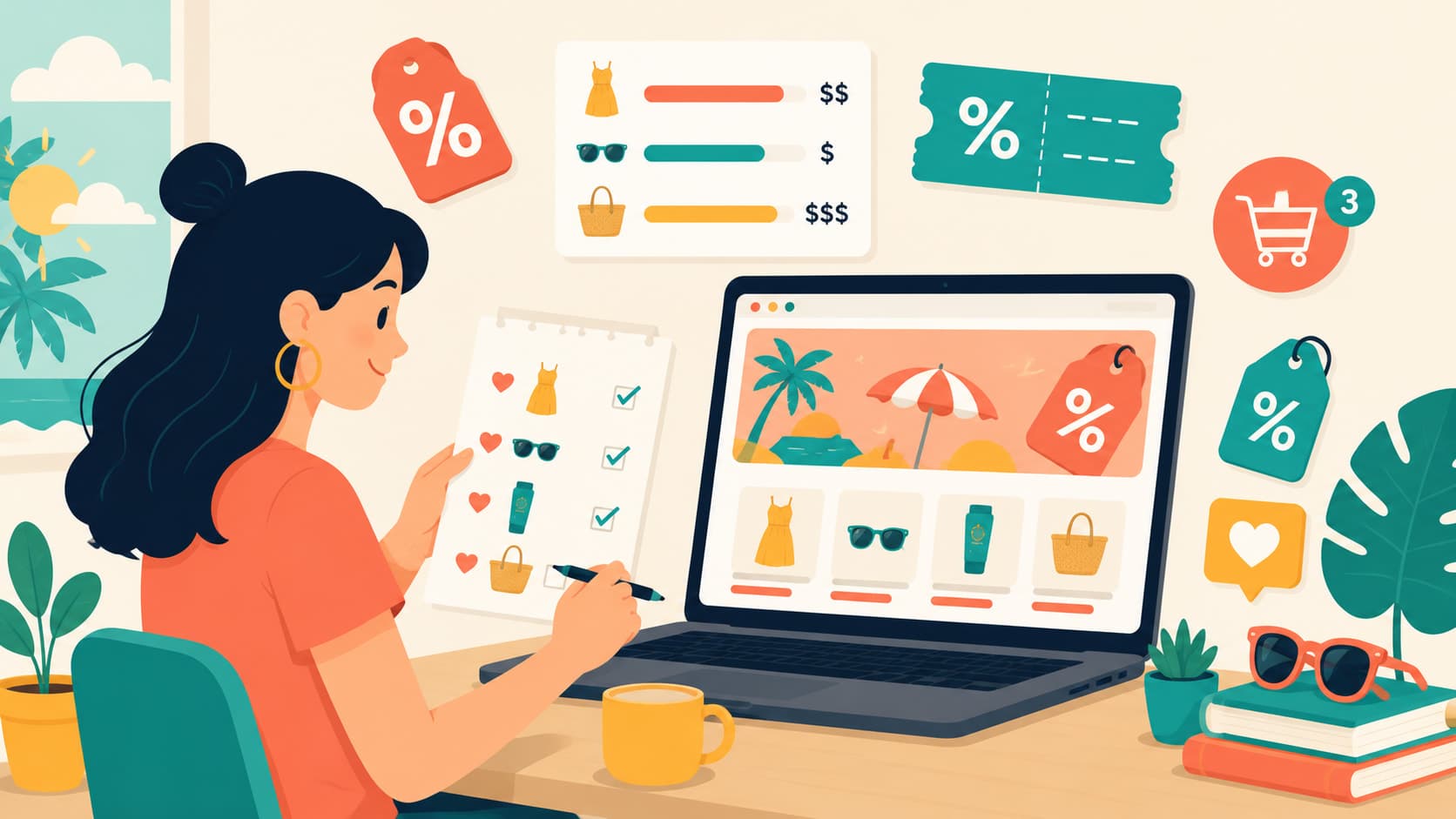
Every July, two shoppers walk into the same summer sale. One walks out with a $900 haul for $520 — all stuff she actually planned to buy. The other walks out with $400 of impulse purchases, three of which get returned, and a nagging feeling that the "70% OFF EVERYTHING" banner may have oversold things a little.
Same sale. Same prices. Completely different outcomes.
The difference isn't luck, and it isn't income. It's preparation. Big summer sale events — the anniversary sales, the 4th of July carryover deals that linger deep into the month, the mid-year clearance purges — are genuinely some of the best buying windows of the year. But they're also engineered, top to bottom, to make you spend more than you meant to. The banners, the countdown timers, the "doorbusters" — all of it is a system, and systems can be played.
This guide is your playbook for playing it well. We'll cover how these events actually work, how to build a wishlist that shops for you, how to get in the door before everyone else, how to spot a fake "sale" price from a mile away, and how to stack promo codes on top of already-discounted items. By the time the next big banner drops, you'll be the first shopper — the one with the plan.
Why Summer Is Secretly One of the Best Times to Shop All Year
Everyone knows about Black Friday. Far fewer people realize that mid-summer is its quieter, arguably friendlier twin. Here's what's happening in retail-land every July:
- Anniversary sales. Several major department stores run their biggest sale of the year in July — including early markdowns on brand-new fall merchandise, which almost never goes on sale otherwise. That last part is the secret: it's one of the only times you can buy next season's items at a discount instead of picking over what's left of last season's.
- 4th of July carryover. The holiday weekend sales officially "end," but a huge chunk of the discounts quietly stick around for one to three weeks afterward. Retailers would rather keep the markdown running than un-sell inventory they already decided to move.
- Mid-year clearance. July sits at the seam between retail seasons. Stores need floor space and warehouse space for fall stock, so spring and summer goods get pushed out at 50–70% off.
- Competing mega-sales. When one giant online retailer runs its famous July deal event, virtually every competitor launches a counter-sale the same week. You benefit from the crossfire whether or not you shop the original event.
Stack all of that together and mid-summer becomes a two-to-four-week window where discounts overlap across nearly every category: apparel, home goods, electronics, beauty, outdoor gear. The catch? The volume of "deals" is so overwhelming that shopping without a plan is basically donating money. So let's build the plan.
Step 1: Build Your Wishlist Before the Sale, Not During It
This is the single highest-leverage move in all of sale shopping, and most people skip it.
A big sale is a terrible place to decide what you want. The banners are loud, the timers are ticking, and every product page is whispering "last chance." Decision-making under those conditions is how carts fill up with regret. The fix: make your decisions before the sale starts, in a calm moment, with no timer in sight.
How to build a wishlist that actually works
- Walk your life, not the store. Check your closet, your kitchen, your gym bag, your kids' fall needs. Write down what genuinely needs replacing or upgrading. This list is your shopping universe — if it's not on the list, it doesn't get bought.
- Add items to store wishlists and carts now. Most retailers let you "heart" items or park them in a saved list. When the sale hits, you check your list in two minutes instead of browsing for two hours.
- Record the current price next to each item. This is crucial and takes ten seconds per item. Write down what the item costs today, before any sale pricing appears. That number is your truth serum later.
- Set a "buy price" for big-ticket items. Decide in advance: "I'll buy the stand mixer if it drops below $280." When it does, you buy without agonizing. When it doesn't, you wait without FOMO.
Bonus effect: items sitting in your cart or wishlist sometimes trigger their own discounts. Retailers monitor saved items, and "an item on your wishlist just dropped in price" emails are a real and glorious thing.
Step 2: Get In Early — Early Access Is Usually Free
Here's something the countdown timers don't tell you: by the time a big sale opens "to the public," the best inventory is often already gone. Popular sizes, top colorways, and doorbuster quantities get picked over during early access — and getting early access is far easier than most shoppers think.
- Loyalty programs. Free-to-join store loyalty programs frequently unlock sale access one to several days early. Signing up takes two minutes and costs nothing.
- Store credit cards. Cardholders often shop anniversary-style sales up to a week before everyone else. (Only worth it if you'd carry the card anyway and pay it off monthly — never open a credit card just for one sale.)
- Email and app subscribers. Brands routinely send subscribers a "shop it first" link before the public launch, plus app-exclusive early windows. That deals-only email address you should already have? This is where it earns its keep.
- Text lists. SMS clubs are the newest early-access channel, and because fewer people join them, the offers are often better than email.
The strategy: two weeks before a known sale event, join the free loyalty program and mailing list of every store on your wishlist. It's ten minutes of setup for first crack at the inventory everyone else will be fighting over.
Step 3: Learn to Spot a Real Discount (Because Many Aren't)
Time for the uncomfortable truth about sale season: a "sale price" is a claim, not a fact.
The classic move is the inflated "compare at" price. An item that has sold for $40 all year gets tagged "Was $79.99 — Now $39.99!" during the sale. Technically it may have been listed at $79.99 for a week last winter. Practically, you're being congratulated for paying the normal price. Regulators have gone after retailers for this for decades, and it still happens constantly — especially during high-traffic events when nobody's checking.
Your three-part lie detector
- Your own wishlist notes. Remember those pre-sale prices you wrote down? Compare. If the "40% off" price matches what you recorded three weeks ago, the discount is theater.
- Price history trackers. Free browser tools and websites chart an item's price over months. One glance tells you whether today's "deal" is genuinely the low point or just a Tuesday.
- Cross-store comparison. Search the exact model number at two or three competitors. During big events, retailers price-match aggressively — and sometimes a competitor's everyday price beats the sale price you're staring at.
Real-world example of why this matters. Say you're eyeing wireless headphones during a July mega-sale:
- Sale listing: "Was $249, now $179 — save $70!"
- Price history: they've sold for $189 most of the year, and hit $159 last November
- Real savings today: $10, not $70 — and history says a better price is likely coming
Thirty seconds of checking just told you this is a "meh" deal wearing a doorbuster costume.
None of this means summer sales are fake — plenty of the discounts are deep and genuine, especially on clearance and event-exclusive items. It means the good deals and the costume deals are shelved side by side, and your job is telling them apart.
Step 4: Stack Promo Codes on Top of Sale Prices
Here's where prepared shoppers pull decisively ahead: the sale price is not the floor. It's the starting point.
A surprising number of shoppers assume promo codes don't work on sale items. Sometimes that's true — clearance and doorbusters are often excluded, and the fine print will say so. But sitewide codes, free shipping codes, loyalty rewards, and cash back offers frequently apply to sale prices just fine. During big events, brands want the checkout to feel irresistible, so they'll happily let discounts pile up.
The stacking order, from top to bottom
- Start with the sale price — the event discount is your base layer
- Apply a promo code — check the store's page on Lyfestic's store directory before checkout to see what's live and verified
- Route through cash back — a percentage back on the already-discounted total
- Redeem loyalty points or rewards certificates — many programs let these combine with everything above
- Pay smart — a discounted gift card or a card with bonus rewards in that category shaves off a final layer
Let's run the full stack on a $220 wishlist order during an anniversary sale:
- Event pricing takes 30% off → $154
- A 15%-off sitewide code applies to sale items → $130.90
- 3% cash back on the total → effectively $126.97
- A $10 loyalty reward you'd banked → $116.97
That's $103 saved — 47% off — on items you were buying anyway. The sale gave you 30%. Preparation gave you the rest.
One practical tip: apply the promo code last, and re-check your order total after any cart change. Codes can silently un-apply when you edit quantities or switch shipping speed, and sale season is exactly when checkout pages get glitchy.
Step 5: Know the Rhythm of the Event Itself
Big sales aren't static — they have phases, and different phases reward different shoppers.
- Early access / day one: best selection, decent prices. Shop now for anything where size, color, or stock matters — apparel, shoes, popular electronics. Waiting for a deeper cut on a hot item usually means watching it sell out instead.
- Mid-sale: "new deals added" waves keep traffic coming. Worth a five-minute check every couple of days against your wishlist — nothing more.
- Final days: prices hit bottom, selection hits bottom too. This is the moment for flexible wants — home goods, basics, anything where you don't care which color survives.
The rule of thumb: shop early for needs, shop late for wants. And if an item on your wishlist never hits your buy price? Let it go. July's sale has a sequel every single year — plus Labor Day, October's fall mega-sales, and November looming right behind it.
6 Summer Sale Mistakes That Drain Your Wallet
Consider this your pre-sale vaccination. The most common ways good shoppers lose money at big events:
- Shopping the sale instead of your list. Browsing "all deals" pages is window-shopping with a checkout button. If it wasn't a need before the banner existed, a discount doesn't make it one — 40% off something you didn't want is still 60% spent.
- Trusting the strikethrough price. "Was $79.99" is marketing copy until price history proves otherwise. Verify before you celebrate.
- Panicking at countdown timers. "Deal ends in 2:14:09!" — and then, mysteriously, it's back next week. Urgency is the oldest tool in the retail toolbox. Your buy price doesn't have a timer.
- Ignoring the return policy. Sale and clearance items sometimes carry shorter return windows or final-sale terms. Know before you buy, especially on apparel you haven't tried on.
- Forgetting to search for a code. The sale price feels like the finish line, so people skip the thirty-second code check that could take another 10–15% off. During big events, more codes are live than at almost any other time — check current promotions before every checkout.
- Buying doorbusters in categories you don't know. That $89 "was $299" blender may be a derivative model made only for sale events, with cheaper components than the real flagship. If a deal on a big-ticket item looks impossible, research the exact model number first.
Frequently Asked Questions
Do promo codes actually work on sale items?
Often, yes — sitewide codes, free shipping codes, and loyalty rewards frequently apply to sale prices. The main exceptions are clearance and doorbuster items, which are commonly excluded in the fine print. It costs nothing to try the code, so always test it before paying.
Are anniversary sale prices really better than Black Friday?
Different, not strictly better. Anniversary sales discount brand-new fall merchandise that rarely goes on sale any other time, while Black Friday goes deeper on electronics and doorbusters. If you want current-season fashion, beauty, and home items, July's events are often the stronger window.
How early should I start preparing for a big sale?
Two weeks is plenty. That's enough time to build your wishlist, record current prices, join the free loyalty programs and email lists of the stores you'll shop, and set buy prices for big-ticket items. Total effort: about an hour, spread across a few evenings.
Is it worth buying fall and winter items during summer sales?
Absolutely — it's one of the smartest plays available. Coats, boots, and fall apparel bought during July events routinely cost 30–50% less than they will in October. Just be confident about sizes, since you may be past the return window before the season starts.
What if the price drops again right after I buy?
Check the retailer's price adjustment policy — many will refund the difference if an item drops within 7–14 days of purchase. One quick email or chat message is often all it takes. This is also why paying with a card that offers price protection can quietly save you real money.
The Bottom Line: The Sale Rewards Whoever Shows Up Prepared
Big summer sale events are neither a scam nor a jackpot — they're a tool, and tools reward skill. Here's the whole playbook in five lines:
- Decide what you want before the banners go up — the wishlist is the plan
- Record real prices in advance so no strikethrough can fool you
- Grab free early access through loyalty programs, email, and apps
- Stack codes, cash back, and rewards on top of every sale price
- Shop early for needs, late for wants — and walk away from anything that misses your buy price
Do that, and you become the first shopper from our opening story: the one who treats a mega-sale like a supply run instead of a slot machine. The sales will keep coming — July, September, November, January, forever. The only question is whether you'll keep showing up with a plan.
Got a sale on your radar? Get your stack ready.
Find verified promo codes for your favorite stores and browse the latest live promotions so you're stacking discounts the moment the doors open.
Happy saving! 🛍️
Related Articles
Explore more articles you might like