End-of-Season Clearance Guide: How to Shop 70% Off Sales
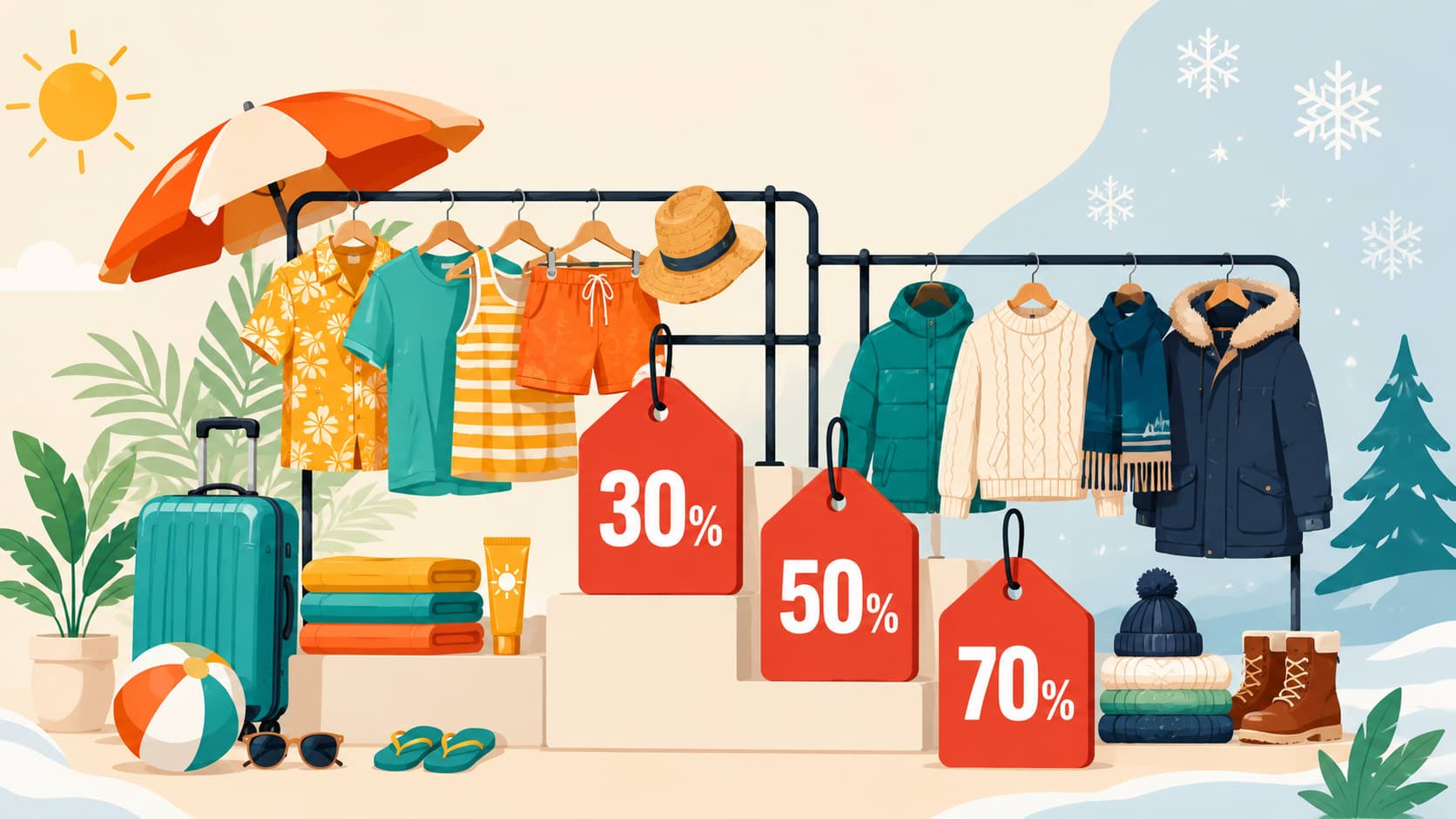
There's a rack at the back of almost every store in America right now, and it's quietly the best deal in the building. No countdown timer. No flashy banner. Just a cluster of red tags and a sign that says Clearance — where a $68 swimsuit is sitting at $20 because the calendar flipped and the store needs it gone.
Welcome to end-of-season clearance, the most predictable — and most misunderstood — savings event in retail.
Twice a year, in January and July, stores hit a wall: the new season's inventory is arriving, the old season's inventory is still on the floor, and there's only so much shelf space. Something has to give, and it's always the price. Shoppers who understand how these clearance windows work routinely pay 50–70% less than everyone else — not on junk, but on the exact same items that were full price six weeks earlier.
This guide walks you through the whole playbook: how markdown cycles actually work, when to pounce and when to wait, the off-season buying strategy that saves serious money year after year, and the caveats (sizes, returns, final sale) that trip people up. By the end, that clearance rack will look less like a pile of leftovers and more like what it really is: the store paying you to have good timing.
Why January and July Are Retail's Two Great Reset Buttons
Retail seasons run about two months ahead of real ones — swimsuits hit the floor in March, wool coats in August. That head start creates two massive collision points every year:
- January: The holidays are over, gift returns are flooding in, and spring merchandise is already shipping from warehouses. Everything winter — coats, sweaters, boots, holiday decor, even fitness gear ordered for resolution season — has to move out fast.
- July: Summer is technically still going strong, but retail has mentally moved on to fall and back-to-school. Swimwear, patio furniture, grills, sandals, sunscreen, camping gear — all of it becomes an obstacle between the store and its autumn floor plan.
Here's the key mental shift: during these windows, the store's incentive flips. For most of the year, retailers protect their margins. In January and July, they're protecting their shelf space — and they will happily sacrifice margin to get it back. A store would rather sell that patio set at 70% off today than pay to warehouse it until next April.
You're just showing up at the exact moment the store wants to lose the negotiation.
How Markdown Cycles Work: The 30% → 50% → 70% Ladder
Clearance isn't one price cut — it's a staircase. Most retailers follow a surprisingly consistent markdown rhythm, and once you can read it, you can predict where a price is headed.
Step 1: The First Cut (Usually 25–30% Off)
This is the polite markdown. The season is winding down and the store is testing the water. Selection is still excellent — every size, every color. For popular items and common sizes, this is often your best realistic buying window, because they may never survive to the next markdown.
Step 2: The Second Cut (40–50% Off)
Two to three weeks later, whatever didn't sell drops again. This is the sweet spot for most shoppers: the discount is meaningful, and the selection — while thinner — is still workable. This is typically where mid-July and mid-January land.
Step 3: The Final Cut (60–70% Off, Sometimes More)
Now the store is done pretending. Items get herded onto a single rack, tags go red, and prices hit the floor. Sizes are picked over, colors are whatever's left, and many items flip to final sale. But when you find your size at 70% off, it feels like winning a small lottery.
Let's put real numbers on the ladder. Say a summer dress starts at $80:
- First markdown (30% off, early July) → $56
- Second markdown (50% off, mid-July) → $40
- Final markdown (70% off, late July/early August) → $24
Waiting three weeks saved $32 — but only if your size survived. That tension is the whole game.
So When Should You Actually Buy?
Here's a simple decision rule that resolves the wait-or-buy dilemma almost every time:
- Buy at the first or second markdown if the item is popular, you wear a common size (medium, size 8 shoes, etc.), or you'd genuinely be disappointed to miss it.
- Wait for the final markdown if you're flexible on color, wear a less common size, or you're browsing rather than hunting a specific item.
- Never wait on the last one. If there's a single unit left in your size at 50% off, the "maybe it'll hit 70%" gamble usually ends with someone else's hands on it.
One more insider detail: many stores process markdowns on a set weekday — often midweek, quietly, in the morning. Shop the same store regularly and you'll learn its rhythm.
The Off-Season Strategy: Buy for Next Year, Not This Year
This is where clearance shopping graduates from "nice discount" to "genuinely different way of buying things."
Most people shop in season: a winter coat in November, when demand peaks and discounts are shallow. Off-season shoppers buy that coat in January at 60% off and let it wait in the closet. Same coat, nearly half the money.
The July version of this strategy is loaded with opportunities right now:
- Swimwear and summer clothing — buy for next summer at 50–70% off. Cotton doesn't expire.
- Patio furniture and grills — among the biggest-ticket clearance items of the year. A $600 patio set at 50% off is a $300 swing on a single purchase.
- Camping and outdoor gear — tents, coolers, and kayaks get cleared to make room for fall inventory.
- Air conditioners and fans — prices sag late in the summer, and next July's heat wave is guaranteed to show up.
- Sandals and summer shoes — footwear clearance in July is consistently deep.
And in January, the mirror image: coats, sweaters, boots, holiday decorations (up to 90% off after December 26), wrapping paper, and cold-weather gear of every kind.
Here's what one year of deliberate off-season buying can look like for a family of four:
- Two kids' winter coats in January: $45 each instead of $90 → saves $90
- Patio umbrella and chair set in late July: $180 instead of $400 → saves $220
- Next summer's swimsuits for the family in August: $60 instead of $170 → saves $110
- Holiday lights and decor on December 27: $25 instead of $100 → saves $75
Total: roughly $495 saved — on things the family was going to buy anyway. That's the entire trick.
Two Rules That Keep Off-Season Buying Smart
Rule one: only buy the predictable. Classic cuts, neutral colors, staple items. A plain black winter coat will still be a plain black winter coat next November. A trend-heavy piece might feel dated before you ever wear it. The same logic applies to kids — buy next year's sizes, not this year's, and lean toward roomy rather than snug, because children have a habit of growing on their own schedule.
Rule two: have a place for it. Off-season buying only works if the item survives storage. A vacuum bag for the coat, a labeled bin for the decorations, a garage corner for the patio set. If "storage" means "a pile," skip it — a bargain you can't find next season is just clutter with a good origin story.
Clearance + Coupons: The Stack That Makes Good Deals Great
Here's the part most clearance shoppers miss entirely: a clearance price is usually not the final price. It's the starting point for a stack.
Many retailers allow promo codes on clearance items — and because the code applies to the already-slashed price, the combined discount gets steep fast. The order of operations looks like this:
- Clearance price — the base, already 50–70% below original
- + Promo code — an extra 15–25% off, if clearance isn't excluded
- + Cash back or loyalty points — a final few percent on top
- + Free shipping threshold — so shipping fees don't eat the win
Run the math on a real example: a $120 jacket hits final clearance at 60% off, so it's $48. The store is running an "extra 20% off" code — those "extra percent off clearance" codes are extremely common in January and July, precisely because stores are desperate to finish the purge. Now you're at $38.40. Route the purchase through a 2% cash back offer and you're effectively at $37.63 — about 69% off the original price.
Two caveats keep the stack honest:
- Read the exclusions. Some codes explicitly exclude clearance (the fine print will say so). Others — especially the "extra X% off sale styles" type — are designed for it. Thirty seconds of reading tells you which one you're holding.
- Check codes before you drive or click. Lyfestic's store directory lists current verified codes by retailer, so you can confirm whether an extra-off-clearance code is live before you commit to the trip or the cart.
The Fine Print: Sizes, Returns, and Final Sale
Clearance has real trade-offs, and pretending otherwise is how people end up with regret in a shopping bag. Know these three going in:
Selection Shrinks as Prices Drop
The markdown ladder and the size rack move in opposite directions. At 30% off, everything's available. At 70% off, you're shopping whatever the crowd left behind — which, oddly, favors people at the ends of the size spectrum. If you wear XS or XXL, deep clearance is disproportionately kind to you, because middle sizes always sell out first.
Final Sale Means Final
Somewhere around the last markdown, many stores flip clearance to final sale: no returns, no exchanges. That changes how you should shop. Try things on in-store when you can. Online, check the measurements chart instead of trusting the size label, and be extra careful with brands you've never worn. A $19 final-sale shirt that doesn't fit isn't a deal; it's a $19 donation with extra steps.
Inspect Before You Buy
Clearance items have usually been handled, tried on, and reshelved for weeks. Check zippers, seams, buttons, and (for boxed goods) whether the box has been opened and repacked. Most items are perfectly fine — but the ten-second inspection matters most when returns are off the table.
5 Clearance Mistakes That Turn Savings into Spending
- Buying it because it's 70% off. The oldest trap in retail. If you wouldn't have wanted the item at full price, the discount isn't saving you money — it's spending 30% on something you didn't need. The question is never "how much off?" It's "would I buy this anyway?"
- Ignoring the per-item math on "extra" markdowns. A $10 item at an extra 20% off saves you $2. Don't add three filler items to feel like you're maximizing a code — filler is filler at any discount.
- Gambling on the final markdown for a must-have. If you love it and it's the last one in your size, 50% off today beats 70% off never. Reserve the waiting game for items you're indifferent about.
- Skipping the final-sale check. Always confirm the return policy before paying, not after. "All clearance final sale" signs have a way of becoming visible only at the customer service desk.
- Buying next-year sizes for kids too precisely. Growth spurts don't consult your shopping plans. When buying children's clothes a year ahead, size up generously — a slightly big coat gets worn; a slightly small one never does.
Your Twice-a-Year Clearance Routine
Want to make this automatic? Put two recurring reminders in your phone — one for early January, one for early July — and run the same simple loop each time:
- Week 1: Walk your favorite stores (or scroll their sale sections) and note what's at first markdown. Buy anything you love in a common size.
- Week 2–3: Return for the second markdown. This is the volume-buying window — best balance of price and selection.
- Week 4+: Hit the final-markdown racks for opportunistic wins and next-year stock-ups.
- Before every purchase: Check for an extra-off code and any live cash back offers on the current promotions page — January and July are peak season for stackable clearance codes.
That's maybe three shopping trips and a few browser tabs, twice a year. In exchange, you get winter coats at summer prices, patio sets at half off, and a closet that quietly cost 40% less than everyone else's.
Frequently Asked Questions
When exactly do January and July clearance sales start?
Winter clearance typically kicks off December 26 (holiday items first) and deepens through mid-to-late January. Summer clearance usually starts around the July 4th weekend and hits final markdowns in late July and early August. Individual stores vary by a week or two, but the pattern holds almost everywhere.
Can I really use coupon codes on clearance items?
Often, yes — it depends on the store and the specific code. Some codes exclude clearance in their terms, while others ("extra 20% off sale styles") exist specifically for it. Always read the code's terms, and check a verified code listing before checkout so you know what's currently stackable.
Is clearance merchandise lower quality or defective?
No — the vast majority is identical to what sold at full price weeks earlier. It's discounted because of the calendar, not the quality. That said, floor items get handled a lot, so give anything a quick inspection before buying, especially if it's final sale.
Should I wait for 70% off or buy at 50%?
Buy at 50% if the item is popular, you wear a common size, or you'd be genuinely bummed to miss it. Wait for 70% when you're flexible on color and style or you're stocking up on basics. The deeper the markdown, the thinner the selection — that trade-off never goes away.
What are the best things to buy on July clearance specifically?
Patio furniture, grills, and outdoor gear offer the biggest dollar savings because their original prices are high. Swimwear, summer clothing, sandals, camping equipment, fans, and air conditioners are the other reliable categories. Buy for next summer and you'll be wearing this July's prices in next July's heat.
The Bottom Line: The Calendar Is the Coupon
End-of-season clearance isn't luck. It's a schedule — 30%, then 50%, then 70%, every January and every July, as dependable as the seasons that cause it. Once you know the rhythm, the strategy runs itself: buy staples off-season, pounce early on must-haves, wait out the rest, stack a code on top, and always check the return policy before you swipe.
The shoppers paying full price in November for the coat you bought in January are simply shopping on retail's schedule instead of their own. Now you know the difference.
July clearance is live right now — don't shop it without a code.
Find verified promo codes for your favorite stores and check the latest stackable promotions before your next clearance run. An extra 20% off a 70%-off price is how good deals become great ones.
Happy saving! 🏷️
Related Articles
Explore more articles you might like