Cash Back Apps vs Coupon Codes: Which Saves You More?
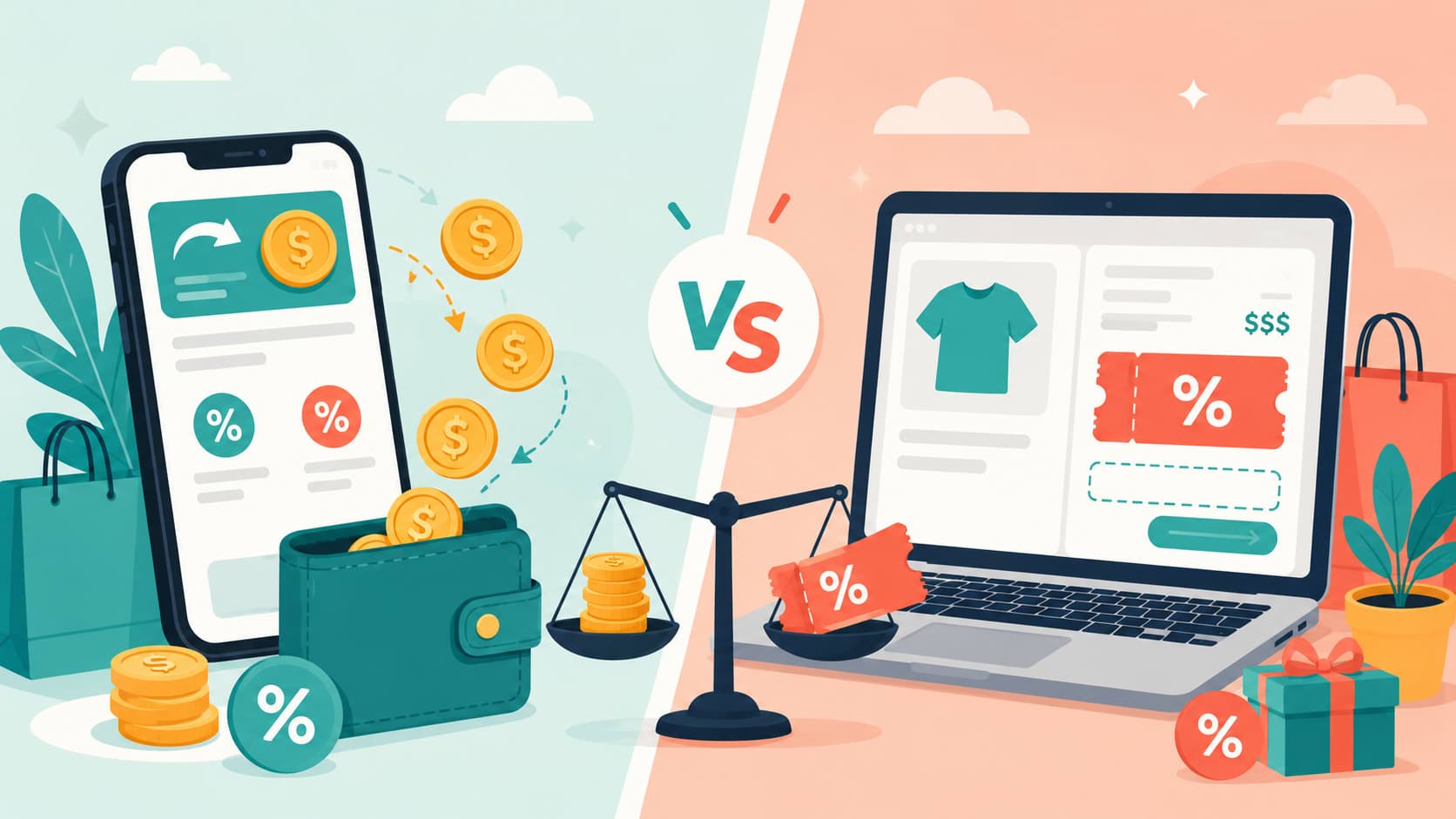
Two friends buy the exact same $120 pair of running shoes from the exact same online store on the exact same afternoon. Jess applies a 15% promo code at checkout. Marcus skips the code but clicks through his favorite cash back app first, earning 8% back. A week later, they compare receipts over coffee. Who actually paid less?
Jess did — she paid $102 on the spot, while Marcus paid $120 and got $9.60 back later, netting out at $110.40. But here's the twist neither of them noticed: the person who really won that afternoon was the hypothetical third friend who did both, paid $102, and collected another $8.16 in cash back on top. Total cost: $93.84 for the same shoes.
That, in one coffee-shop anecdote, is the entire cash back vs. coupon codes debate. Both save you money. Both are free. And treating them as an either/or choice is the single most expensive mistake casual shoppers make. This guide breaks down how each one actually works, when one clearly beats the other, and how stacking them turns ordinary shopping into a few hundred dollars of found money every year.
How Coupon Codes Work (and Why Stores Love Handing Them Out)
A coupon code is an instant discount — a string like SUMMER20 that you type into the promo box at checkout and watch your total drop before you pay. The savings are immediate, visible, and locked in the moment you place the order.
Stores issue codes for very deliberate reasons: to win first-time customers, to lure back people who haven't ordered in a while, to clear seasonal inventory, and to track which marketing channels are actually working. The discount is a planned business expense, budgeted right alongside advertising. When you use a code, you're not sneaking anything past the store — you're accepting an offer they printed money to make.
Codes typically come as:
- Percentage discounts — 10% to 30% off is common; 40%+ shows up around big sale events
- Dollar-amount discounts — $10 off $50, $25 off $100, and similar threshold deals
- Free shipping codes — quietly the best value on small orders
- Free gift or bonus offers — spend a minimum, get an extra item tossed in
The strength of a code is that it's money you never spend. Your credit card is charged the lower amount. There's no waiting, no minimum payout, no app to remember. The weakness? Codes are unpredictable. Some stores always have one running; others go months without a public code, and the one you find may exclude the exact item in your cart.
How Cash Back Apps Work (and Where That Money Comes From)
Cash back apps and sites flip the timing. You pay full price (or sale price) today, and a percentage of your purchase comes back to you later — usually as a PayPal transfer, direct deposit, or gift card, and usually after a waiting period of 30 to 90 days.
The money isn't magic, and it isn't a gimmick. Here's the pipeline:
- The store pays a commission — retailers pay affiliate platforms a percentage of every sale those platforms send them, because a paid-out commission on a real sale beats an ad that might not convert.
- The platform splits it with you — a cash back app takes that commission and hands a chunk of it back to the shopper as "cash back."
- You get paid for shopping you were doing anyway — as long as you remember to click through the app or site before buying.
Worth knowing: this is the same commission model that funds legitimate coupon platforms. When you grab a verified code from a site like Lyfestic, the store pays a small commission on your purchase — you never pay a cent for the service. Store-funded commission is what keeps both codes and cash back free for shoppers.
Typical cash back rates run 1% to 5% at most major retailers, with occasional boosted events pushing specific stores to 10% or even 15% for a day or two. Those boost days matter — a store that normally pays 2% suddenly paying 12% changes the math on a big purchase completely.
The Head-to-Head Math: Which One Saves More?
Time to settle it with numbers instead of vibes.
Round 1: The Everyday Order
You're buying $80 of clothing. Your two options:
- A 20% promo code: you pay $64. Savings: $16, instantly.
- 4% cash back: you pay $80 now, get $3.20 back in a month or two. Savings: $3.20, eventually.
Winner: the code, by a factor of five. It's not close.
This is the pattern for most everyday purchases. Promo codes routinely knock off 10–25%, while standard cash back rates hover in the low single digits. When a decent code exists, it almost always beats cash back on its own.
Round 2: The No-Code Store
But plenty of purchases have no working code at all. Big electronics retailers, marketplaces, airlines, and stores that "never discount" are famous for it. On those orders, the comparison is 0% versus something:
- No code available: you save $0.
- 3% cash back on a $600 laptop: you get $18 back.
Winner: cash back, because $18 beats nothing every time. Cash back's superpower is coverage — it works on nearly every order at participating stores, including full-priced items no code will ever touch.
Round 3: The Boosted-Rate Big Purchase
Now the fun one. Say a furniture store is running a 12% cash back boost, and the best public code is 10% off:
- 10% code on a $1,000 sofa: pay $900. Savings: $100.
- 12% boosted cash back: pay $1,000, get $120 back. Savings: $120.
Winner: cash back — one of the rare occasions it out-punches a code head-to-head. Boost events and big-ticket items are exactly when it pays to check the cash back rate before assuming the code wins.
The Scorecard
- Bigger single discount: coupon codes, usually. Double digits beat single digits.
- Works on more purchases: cash back. It doesn't care whether a code exists.
- Speed: codes. Instant discount versus a 30–90 day wait and a payout minimum.
- Reliability: cash back. Codes expire, exclude items, and fail; a tracked click-through pays quietly in the background.
- Big-ticket boost days: cash back can win outright.
The Real Answer: Stop Choosing and Stack Them
Here's the part the "versus" framing hides: at most stores, you don't have to pick. Cash back is typically calculated on whatever you actually pay — which means you can apply a promo code first and then earn cash back on the discounted total.
The routine takes about sixty seconds:
- Step 1 — find your code first. Look up the store on a verified coupon platform and note the best working code before you start checkout.
- Step 2 — click through your cash back app or site. This activates tracking, so the purchase gets credited to you.
- Step 3 — apply the code at checkout. Your total drops immediately.
- Step 4 — pay with a rewards credit card if you have one. That's a third layer — 1.5–2% back from your card issuer on top of everything else.
Full stack on a $200 order:
- Apply a 20% promo code → you pay $160
- Earn 5% cash back on $160 → $8 back
- Pay with a 2% rewards card → $3.20 back
- Effective cost: $148.80 — a 25.6% total discount, with zero luck involved.
One caution: some stores reduce or void cash back when certain codes are used, especially codes that didn't come from the cash back platform itself. It doesn't happen often, but if a purchase is huge and the cash back rate is the main prize, use the code the platform lists to keep both layers intact.
What This Adds Up to Over a Year
Small percentages feel like pennies until you multiply them by twelve months of normal life. The average American household spends several hundred dollars a month on online-purchasable stuff — clothes, household goods, gifts, electronics, travel, pet supplies. Run even modest savings across that spending:
- $400/month routed through cash back at an average 3% → about $144/year, for clicking one extra button.
- A working code on half your orders averaging 15% off → roughly $360/year on that same spending.
- A 2% rewards card across everything → another $96/year.
Realistically — because nobody stacks perfectly, codes don't always exist, and some months you barely shop — households that build the habit reliably land in the $300 to $600 per year range just by routing purchases they were already making through the right platforms. Heavy online shoppers and anyone booking travel can clear that comfortably. That's a car payment, a weekend trip, or a very nice holiday budget, recovered from purchases that were happening anyway.
Mistakes That Quietly Eat Your Savings
Both tools have failure modes, and they're all avoidable:
- Forgetting to activate cash back before checkout. The number one killer. If you don't click through first, the purchase doesn't track and there's no fixing it afterward. Make the click-through as automatic as fastening a seatbelt.
- Letting a tiny discount justify a purchase. Getting 4% back on something you didn't need means you spent 96% on something you didn't need. Cash back is a rebate, not a reason.
- Grabbing the first code instead of the best one. Stores often run a percentage code and a dollar-off code simultaneously. On a $60 order, "$15 off" beats "10% off" by nine dollars. Compare before applying.
- Ignoring payout thresholds and expiration. Some cash back platforms hold your balance until you hit a minimum, and unclaimed balances can expire. Set a reminder to cash out a couple of times a year.
- Shopping in the app after clicking through in the browser. Switching devices or apps mid-purchase can break tracking. Finish the order in the same window you clicked through.
- Assuming the code always wins. On boost days and big-ticket items, a 10–12% cash back rate can beat the best available code. Check both numbers when the purchase is large.
So When Should You Use Which?
A simple decision rule covers nearly every situation:
- Good code available? Use it — and click through cash back anyway. The stack is the default play.
- No code exists? Cash back alone still beats paying sticker price with nothing back.
- Cash back boost over ~10% on a big purchase? Compare it directly against the best code, and follow the platform's own code to protect the payout.
- Small order with a shipping fee? A free shipping code often beats both percentage plays. Kill the $7.99 fee first.
The one-line version: codes for depth, cash back for breadth, both whenever possible. Keeping a verified code source bookmarked — Lyfestic's promotions page is built for exactly this — means step one of the stack never takes more than a few seconds.
Frequently Asked Questions
Can I really use a coupon code and earn cash back on the same order?
At most stores, yes. Cash back is usually calculated on your final discounted total, so the code and the cash back layer stack cleanly. A minority of retailers void cash back when outside codes are used — for large purchases, use the code listed by the cash back platform itself to stay safe.
Why does cash back take so long to arrive?
The store waits out its return window before confirming the sale and paying the commission, and the platform waits to be paid before paying you. That chain typically takes 30 to 90 days. It's slow, but it's the normal mechanics of the system, not a red flag.
Are cash back apps actually free, or is there a catch?
Legitimate ones are genuinely free. They earn a commission from the store on your purchase and share part of it with you. The "catch" is behavioral: the apps hope the promise of cash back nudges you to shop more. Stick to purchases you already planned and the math stays entirely in your favor.
Which one is better for big purchases like laptops or furniture?
Run both numbers. A 15–20% code usually wins, but big-ticket categories are exactly where boosted cash back rates show up. On a $1,000 purchase, the gap between a 10% code and a 12% boost is $20 — worth thirty seconds of checking.
Do I need a dozen apps to make this work?
No, and you shouldn't. One reliable cash back platform, one trusted source of verified codes, and a rewards card you already own cover 95% of the value. Juggling five apps for an extra half percent is how people burn out and quit saving entirely.
The Bottom Line
Coupon codes deliver the bigger instant discount. Cash back covers the purchases codes can't reach and quietly pays you all year. Framed as rivals, each looks incomplete; framed as layers, they're a system that routinely takes 20–25% off orders and returns $300–$600 a year to people who simply built a sixty-second habit.
Jess and Marcus both did fine. The third friend — the one who stacked — did better. Be the third friend.
Start your stack with the code.
Find verified coupon codes for your favorite stores, check the latest promotions, then activate your cash back and watch both layers work on your very next order.
Happy stacking! 💵
Related Articles
Explore more articles you might like